Question 23.3
A 22 year-old-female presents following voluntary ingestion of 20 g of amisulpride (an atypical antipsychotic / anti-depressant).
ECG 1:

ECG 2:
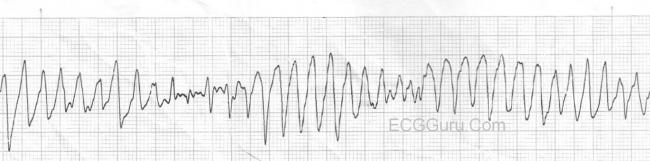
You are given the following ECG (ECG 1) and notice the changes seen on the second ECG tracing (ECG 2) whilst you are reviewing the patient.
- What is the primary abnormality seen on the first ECG?
- What is the abnormality seen on the ECG tracing (ECG 2)?
- What is the most likely cause of this abnormality?
- What is the management of this problem?
College Answer
- .Prolonged QT.
- Torsades de pointes.
- QT prolongation secondary to amisulpride intoxication.
- Resuscitation with respect to ABC
- Correct abnormalities and administer electrolytes
- Intravenous magnesium sulfate
- Treatment of hypokalemia
- Consideration of acute cardiac pacing
- Monitoring
- Correct abnormalities and administer electrolytes
Discussion
With the amisulpride being mentioned in the text, one anticipates both a long QT and torsades.
The 12-lead ECG above is actually from a paywall-protected MJA article about the dangers of QT prolongation in amisulpride toxicity.One can see the faint penstrokes of the MJA authors, where they clearly either measured or calculated the QT in their ECG.
It would be unforgiveable to omit the reference to LITFL, and particularly to their page on QT interval estimation.
As for torsades de pointes, it is a fairly straightforward answer.
- Confirm cardiac arrest
- Proceed with normal basic and advanced life support algorithm (for shockable rhythm) with emphasis on the use of lots and lots of magnesium sulfate.
- If the patient is not arrested but is haemodynamically unstable, you attempt a DC cardioversion as you would for any broad-complex arrhythmia
- If the patient is stable and able to tolerate this arrhythmia (which is unlikely) one may attempt to addess it chemically, with something like a magnesium sulfate bolus.
- Additionally, you may want to avoid amiodarone.
- Then, one may wish to take some preventive measures:
- In congential long QT syndrome, you typically decrease the heart rate with beta blockers. NOT SO for drug-induced long QT. These people need to go faster. Pacing or isoprenaline maybe required if they constantly have episodes of torsades.
References
John, Sally, Phebe O'Mullane, and Sophie Gosselin. "Amisulpride deliberate self-poisoning causing severe cardiac toxicity including QT prolongation and torsades de pointes." Med J Aust 184.7 (2006): 354-356.
Roden, Dan M. "Antiarrhythmic drugs: from mechanisms to clinical practice."Heart 84.3 (2000): 339-346.
Ayad, Ramy F., et al. "Causes and management of drug-induced long QT syndrome." Proceedings (Baylor University. Medical Center) 23.3 (2010): 250.
Gowda, Ramesh M., et al. "Torsade de pointes: the clinical considerations." International journal of cardiology 96.1 (2004): 1-6.
Karunasekara, Niroshini, Michael Wilcox, and Nigel Tufft. "Cardiovascular management of amisulpride overdose." Journal of the Intensive Care Society 13.2 (2012): 160-162.