Response to 1L of PlasmaLyte 148
What am I giving?
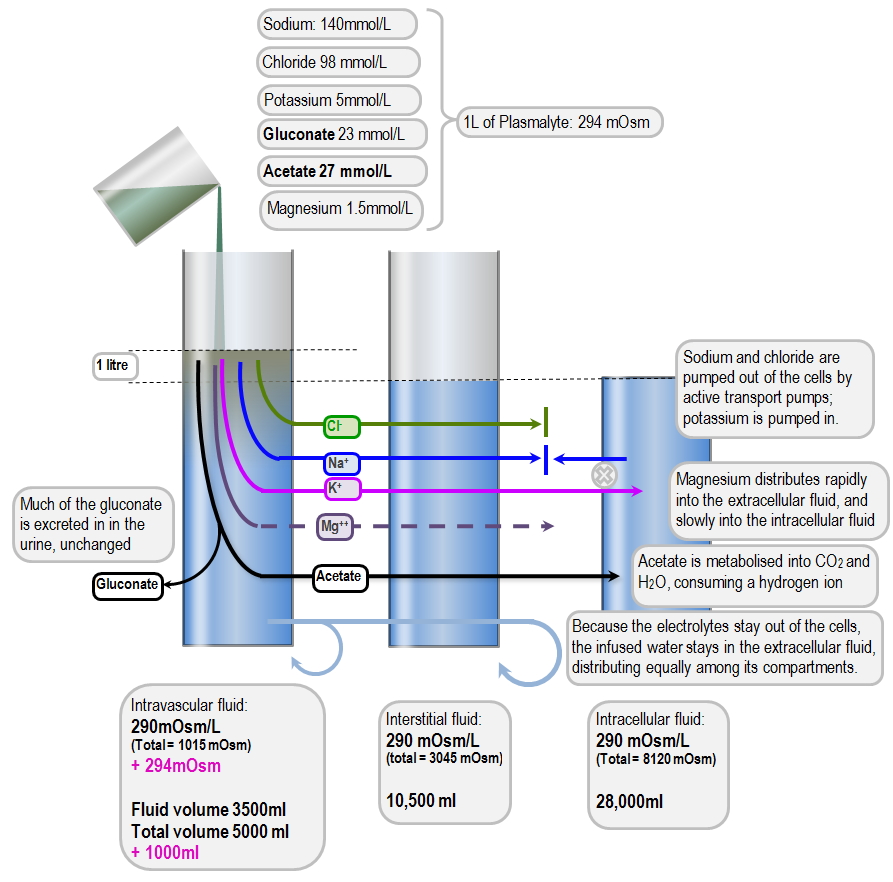
Plasma-Lyte 148 is a cocktail of electrolytes described elsewhere. There seems to be some disagreement as to what exactly it contains and how its osmolality is reported varies, so the reader is left to make up their own mind on the basis of what they see written on the bag. The UK manufacturer propaganda rounds calculated osmolarity to 295, US round down to 294, the Australian product information (and the PLUS study) give 271 mOsm/kg, and Bala et al (2022) give 273 mOsm/kg. All of these authors report the exact same ionic composition, and aadding the listed ions gives 140 + 5 + 1.5 + 98 + 27 + 23 = 294.5 mmol. But because they all interact with each other and with random bystander molecules, they depart from this ideal value, i.e their osmotic coefficient is lower (~0.92). To incorporate this level of complexity into the simple model below would stretch the author's already tenuous grasp of simple maths (he already messed them up at least six times, judging by how often this diagram has had to be re-uploaded because of reader comments). In the end, it was simpler to do a basic headcount of ions without trying to figure out how they behave when they transition from the complex aqueous solution to the infinitely more complex soup that is the human blood.
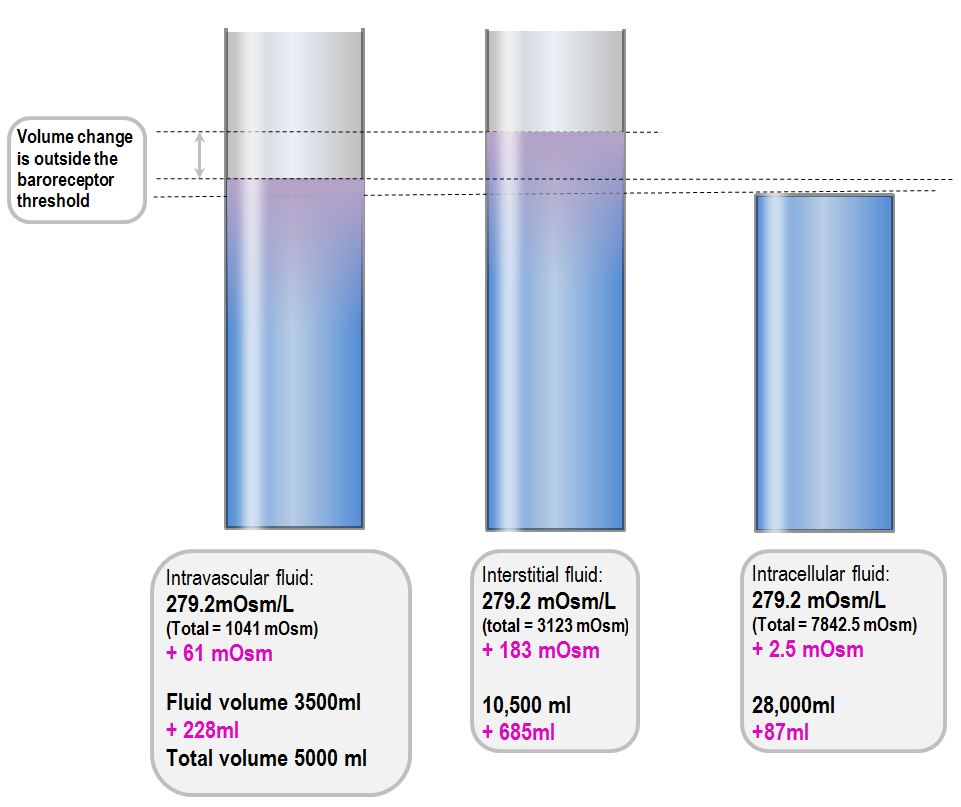
Change to the initial conditions: distribution of volume
In this simplified beaker model, 61 mOsm are added to the intravascular compartment, 183 mOsm to the interstitial compartment and 2.5 mOsm to the intracellular compartment. The water distributes rapidly (within about 15 minutes) from the intravascular to the interstitial compartment, and becomes trapped there. All the electrolytes in it (except for the acetate and gluconate) end up trapped in the extracellular space, and the water has nowhere to go. The acetate and gluconate remain in the bloodstream only transiently (well, gluconate hangs around for longer, perhaps even for hours), and being bicarbonate precursors, they are ineffective osmoles, and vanish from our calculations.
So, in fact we have diluted the concentration of electrolytes in the body fluid compartments with Plasma-Lyte.
Changes in initial conditions: distribution of the major electrolytes
61 mOsm of the electrolytes end up in the intravascular fluid, and 183 in the extravascular.
If we consider that the sodium concentration is initially 140, then it will rise by 0.8 mmol/L.
If the chloride was initially 100, it will rise by 0.4 mmol/L.
Osmoreceptor response
Since the osmolality of the compartments decreases by only 10.8 mOsm/L, there is some minimal osmoreceptor response (this represents a slightly more than 3% change).
Baroreceptor response
The intravascular compartment volume increases by 228ml – from 5000ml to 5228ml. The increase in intravascular volume is 4.5% - outside the volume receptor sensitivity threshold.
Glomerulotubular balance response
This is explained in detail elsewhere.
Has anybody ever infused Plasma-Lyte into healthy volunteers?
But of course. The great guru of applied fluid physiology, Dr Lobo, is a co-author of this recently published paper.
Following the infusion of 2 L of Plasmalyte 148, an initial increase of plasma volume of 29% was observed; at the end of 4 hours only 14% remained. (that would be 7% with 1 litre, or 245mls in our model). As predicted, hyperchloraemia did not occur.
References
Chowdhury AH, Cox EF, Francis ST, Lobo DN. A randomized, controlled, double-blind crossover study on the effects of 2-L infusions of 0.9% saline and plasma-lyte® 148 on renal blood flow velocity and renal cortical tissue perfusion in healthy volunteers. Ann Surg. 2012 Jul;256(1):18-24.
Davies, Paul G., et al. “Plasma acetate, gluconate and interleukin-6 profiles during and after cardiopulmonary bypass: a comparison of Plasma-Lyte 148 with a bicarbonate-balanced solution.” Critical Care 15.1 (2011): R21.
Bala, Renu, et al. "Comparison and evaluation of two different crystalloids-Normal saline and plasmalyte in patients of traumatic brain injury undergoing craniotomy." Brain Circulation 8.4 (2022): 200.
Finfer, Simon, et al. "Balanced multielectrolyte solution versus saline in critically ill adults." New England Journal of Medicine 386.9 (2022): 815-826.