Effects of catecholamine receptor activation
This chapter is relevant to Section M2 (ii) of the 2023 CICM Primary Syllabus, which expects the exam candidates to "Outline the mechanisms by which drugs may affect neurotransmission and noradrenaline effect at the sympathetic nerve terminal". Or perhaps it is from M1(i), "Describe the autonomic nervous system, including anatomy, receptors, subtypes and transmitters (including their synthesis, release and fate)." Apart from Question 12 from the second paper of 2023, the only other vaguely relevant past paper question touching on this topic was Question 23 from the second paper of 2011, which asked for the "production, release, and fate of noradrenaline at the sympathetic nerve terminal". Still, it seems important to know what all the catecholamine receptors subtypes do, and where they are, considering ICU staff tend to use alarming doses of these dangerous drugs.
Catecholamine receptor effects in brief summary:
- α receptors: G-protein coupled receptors
- α-1 : Gq protein coupled – second messenger is IP3, causing an increase of intracellular calcium
- Arteriolar vasoconstriction
- Contraction of the radial muscle of the iris (dilates pupil)
- Contraction of the gut sphincters
- Decreased secretion of intestinal glands
- Contraction of the urethral sphincter
- Increased sodium reabsorption in the renal tubule, and increases renin release
- Contraction of piloerector muscles
- α-2– Gi protein coupled – inhibit adenylyl cyclase, decrease cAMP
- Peripheral effects:
- Relaxation the walls of the gut wall smooth muscles
- Inhibition of noradrenaline release from nerve terminal
- Inhibition of adrenaline release from the adrenal cortex
- Inhibition of insulin release (α-2A)
- Central effects:
- Sedating, antinociceptive effects
- Presynaptic inhibition of norepinephrine, dopamine and serotonin release - thus, systemic sympatholytic effects
- Peripheral effects:
- α-1 : Gq protein coupled – second messenger is IP3, causing an increase of intracellular calcium
- β receptors: Gs protein coupled – activate adenylyl cyclase, increase cAMP levels
- β-1: equal affinity for adrenaline and noradrenaline
- accelerates sinoatrial node
- accelerates ectopic pacemakers
- increases contractility of the heart
- increases rennin release by the kidney
- β-2: minimal affinity for noradrenaline; found on tissues which do not receive direct sympathetic innervation; mostly a receptor to catch circulating adrenaline
- accelerates sinoatrial node
- accelerates ectopic pacemakers
- increases contractility of the heart
- relaxes the smooth muscle of skeletal muscle arterioles
- relaxes bronchiolar smooth muscle
- relaxes gut wall smooth muscle
- relaxes the bladder wall
- relaxes the pregnant uterus
- increases gluconeogenesis and glycogenolysis in the liver
- β-3: minimal affinity for noradrenaline
- all these do is increases the rate of lipolysis in fat cells
- β-1: equal affinity for adrenaline and noradrenaline
The reader lacking in patience for this topic is invited to share the authors';s frustration with a lack of high quality sources for this topic, made frustrating because papers with inviting titles like Cicarelli et al (2017) or Strossberg (1993) turned out to be swamps of thick molecular physiology or random digressions on antioxidant scavenging. Unusually, even the typically lucid chapters of the Primer on the Autonomic Nervous System by Biaggioni et al (Fourth Edition, 2023) did not yield very much useful information for this section. For some reason very few authors have published anything like "Adrenergic receptors: only what you need to know, so that you do not enrage the cardiac anaesthetist with your ignorance". The nearest thing is probably this from Annales d'Endocrinologie, but it is not free and one may have to commit crimes to get it. In which case, if one were going to be lawless anyway, one would be better off acquiring an illegally pirated copy of Tank & Wong (2014), which is comprehensive, beautifully structured, and only slightly longer. That, and the excellent first chapter from Janig (2022), were the main references for the receptor actions and subtype-specific activity in the following summaries. Unless otherwise referenced, all the wild statements made below have originated from these two sources.
Classification of adrenergic receptors
Like everything else that was discovered by rich people performing cruel experiments on fluffy family pets, the classification of adrenergic receptors into classes was purely functional and originally based on the responses of different tissues to adrenaline noradrenaline and (later) isoprenaline. Specifically, Raymond P Ahlquist used Greek letters to describe the two main subtypes of receptors in his seminal 1948 paper mostly because to use "E" and "I" (for "excitatory" and "inhibitory"), as he originally intended, would not be possible because of the "opposite effects associated with each type of receptor", i.e. each had both excitatory and inhibitory effects depending on which tissue was being examined. Interestingly (or perhaps not), the original paper used "alpha" and beta" instead of publishing the actual Greek letters. He did not get much buy-in from the scientific community, who were questioning his classification years later. These days it is a well accepted maxim and integrated into the IUPHAR definitive classification of receptors. Subsequent research had also split the receptors into subgroups, and now we have nine:

|
α-1 receptors
|
α-2 receptors
|
β-receptors
|
Do I seriously need to learn all of these subtypes, the CICM exam-focused reader may be wondering as they reconsider their training pathway. No, probably not; as we do not yet have clinically relevant availability of highly subtype-specific ligands for a lot of these, and moreover their roles are still being debated. To have a clear understanding of the main four (α-1, α-2, β-1 and β-2) would probably be enough. In general, the reader with fantasies of escaping from ICU training on grounds of physiological complexity is reminded that elsewhere in critical care one would often still be called upon to use the same agents that target these receptors, but without the benefit of CICM exam preparation.
α-1 receptor intracellular signalling pathway
These are Gq-protein coupled receptors, heptaspanning membrane proteins. Activating these receptors leads to smooth muscle contraction, by stimulating the release of calcium from the sarcoplasmic reticulum:

These receptors sit on the ends of sympathetic nerve fibres, and their distribution is generally limited to tissues that receive direct sympathetic innervation. Yes, there is a nonzero amount of circulating noradrenaline, and this can also land on these receptors randomly, but there do not appear to be any tissues that are dependent on this "endocrine" effect.
Effects of activating α-1 receptors
- Airway and respiratory effects:
- Decreased secretions in the bronchial glands
- Circulatory effects
- Vasoconstriction of arteries in:
- Skin and mucosa
- Skeletal muscle
- Splanchnic circulation
- Slight vasoconstriction of some critically important arteries:
- Coronary arteries (local effects still result in vasodilation)
- Cerebral arteries (very minor influence)
- Pulmonary erteries
- Significant vasoconstriction of the arteries of the abdominal viscera
- Significant vasoconstriction of the renal arteries
- Significant vasoconstriction of the arteries of the salivary glands
- Vasoconstricts the veins
- Vasoconstriction of arteries in:
- Neurological effects
- Contraction of the radial muscle of the iris, dilating the pupil
- In the CNS, mediates learning and memory, and mostly have a presynaptic inhibitory function
- Exocrine gland effects
- Slightly increases lacrimation (weak effect, its mainly a parasympathetic thing)
- Localised sweating
- Increased salivation (again, not a very strong effect - this is mostly a parasympathetic function)
- Endocrine gland and metabolic effects
- Increased glycogenolysis and gluconeogenesis in the liver
- Decreased pancreatic secretions (digestive enzymes)
- Increased lipolysis and thermogenesis at the adipocyte
- Gastrointestinal effects
- Decreased motility and tone of the stomach
- Contraction of the gastric sphincters
- Decreased motility and tone of the intestine
- Contraction the intestinal sphincters
- Causes contraction of the splenic capsule (in some animals, this causes an autotransfusion of a significant volume of blood)
- Renal and genitourinary effects
- Increased renin secretion by the kidney
- Contraction the trigone of the bladder, and the urinary sphincter
- Increased the motility and tone of the ureter
- Contraction a pregnant uterus
- Ejaculation
- Thermoregulatory effects
- Piloerection in the skin
If you can come up with a dirty mnemonic for this, you deserve a medal. But perhaps a much better way to remember these effects would be by contemplating the pharmacodynamic effects of a pure full agonist, for example something like phenylephrine.
Having already mentioned that a discussion of receptor subtypes would be fruitless and irrelevant, it would be amiss of this website not to offer a lengthy digression on the subject. Unfortunately for the student of physiology, the subtypes of α-1 receptors are not especially memorable and can be summarised briefly as "α-1A does everything". The unafraid reader is carefully positioned in front of Graham et al (1996), with a warning that they may lose some hours to this rabbit hole. In short, our knowledge of the roles and responsibilities of these receptors is rather patchy, and mostly comes from piles of dead trangenic knockout mice, where the most popular experiment seems to be "let's see what happens to their circulatory system when they're born without this one".
- The α-1A subtype seems to be responsible for most of the "classical" α-1 effects, such as vasoconstriction, and if one is pushed against the wall with the questions "which α-receptor subtype does this thing?" the answer could safely be "α-1" in 90% of cases. They are mostly distributed on the post-synaptic membranes of sympathetic nerve terminals, mostly on the surface of smooth muscle. The only widely available α-1A-selective agents are the "metazoline" group of imidazoline receptor agonists, which are mostly used as nasal decongestants (eg. oxymetazoline and xylometazoline).
- α-1B receptors are found in all kinds of places, including the peripheral circulatory system (where they do not necessarily associate directly with sympathetic nerve endings), and the heart (where they mediate some positive inotropic effects, increasing the effects of β-receptor stimulation). They seem to be important for some kind of postural blood pressure regulation, seeing as genetic knockout mice tend to have terrible baroreceptor function without them (Townsend et al, 2004)
- α-1C receptors do not actually exist, and we have skipped this letter because of some hilarious laboratory fuckaround (in summary, they cloned something that turned out to be just more of the 1A subtype, but because by this stage 1D receptors had already been identified, IUPHAR decided that the least embarrassing action would be to delete the 1C subclass entirely, and to pretend like it never existed).
- α-1D receptors do exist and seem to also be responsible for some vasoconstrictor effects, mostly in the coronary arteries and the aorta. As neither the coronaries nor the aorta are especially important targets for vasoconstrictor drugs used in the ICU, these receptors remain irrelevant to the CICM exam candidate.
α-2 receptor intracellular signalling pathway
These are Gi protein coupled receptors. The"i" is for inhibition; the end effect of the secondary messenger cascade is the deactivation of adenylyl cyclase. Active adenylyl cyclase activates cyclic aMP, which is a widespread second messenger; which means the effect of alpha-2 activation is a decrease in cAMP.

There is a greater pharmacological relevance for the α-2 receptor: in the CNS, presynaptic α-2 receptors inhibit the release of noradrenaline. This means α-2 agonists which penetrate the central nervous system act as sympathetic antagonists. Three examples of this are clonidine, methyldopa and dexmedetomidine.
Effects of activating α-2 receptors
In short, these tend to do the opposite of whatever α-1 receptors do, except for where it comes to the circulatory and gastrointestinal system:
- Circulatory effects
- Vasoconstriction of arteries and veins much the same as α-1 receptors, except with different selectivity, and they are present at non-synaptic sites
- Neurological effects
- In the CNS, analgesic and sedating effects, and sympatholytic by a presynaptic inhibitory function
- Exocrine gland effects
- Slightly increases lacrimation (weak effect, its mainly a parasympathetic thing)
- Localised sweating
- Increased salivation (again, not a very strong effect - this is mostly a parasympathetic function)
- Endocrine gland and metabolic effects (α-2A)
- Significantly decreases the secretion of insulin
- Inhibits lipolysis at the adipocyte (opposite of what α-1 receptors do)
- Gastrointestinal effects (α-2A)
- Depress peristalsis and increase sphincter tone, much as α-1 receptors
Subtype effects are probably with discussing, albeit briefly. For something more detailed, one is offered Giovannitti et al (2015). Again, as for α-1 receptors, one subtype (2A) seems to be the most important:
- α-2A receptors are presynaptic "autoreceptors" that sense the release of noradrenaline from the presynaptic membrane and then mediate the downregulation of further noradrenaline release, thereby participating in a negative feedback loop that makes α-2A agonists sympatholytic instead of sympathomimetic. Their most important activity is therefore in the central nervous system, and their most important pharmacological relationship is with clonidine and dexmedetomidine. They also happen to be expressed in the gut (mediating the constipation associated with clonidine use), and in the pancreas (where activation of α-2A receptors leads to a decrease in insulin secretion).
- α-2B receptors are present in the peripheral circulation and do not appear to be strongly associated with nerve endings, suggesting that adrenaline is their main ligand. The only drug to ever selectively target these receptors was imiloxan, a failed anti-depressant from the 1980s. They appear to mediate vasoconstriction.
- α-2C receptors seem to mainly be distributed to the CNS and their activation mediates a lot of the sedating analgesic and sympatholytic effects of centrally acting α-2 agonists. Extremely chill mice overexpressing α-2C receptors appear to be virtually immune to the effects of amphetamines and readily develop behavioural despair when faced with mildly challenging tasks such as the forced swimming test, suggesting these receptors play a fundamental role in the human condition.
β receptor intracellular signalling pathway
These are all Gs-protein coupled receptors. All the beta receptors increase the synthesis of cAMP, which means it would be fair to say that all excitable tissues become more excitable with extra cAMP. This statement is odd, as in fact some of these tissues relax in response to β receptor activation. More on that later.
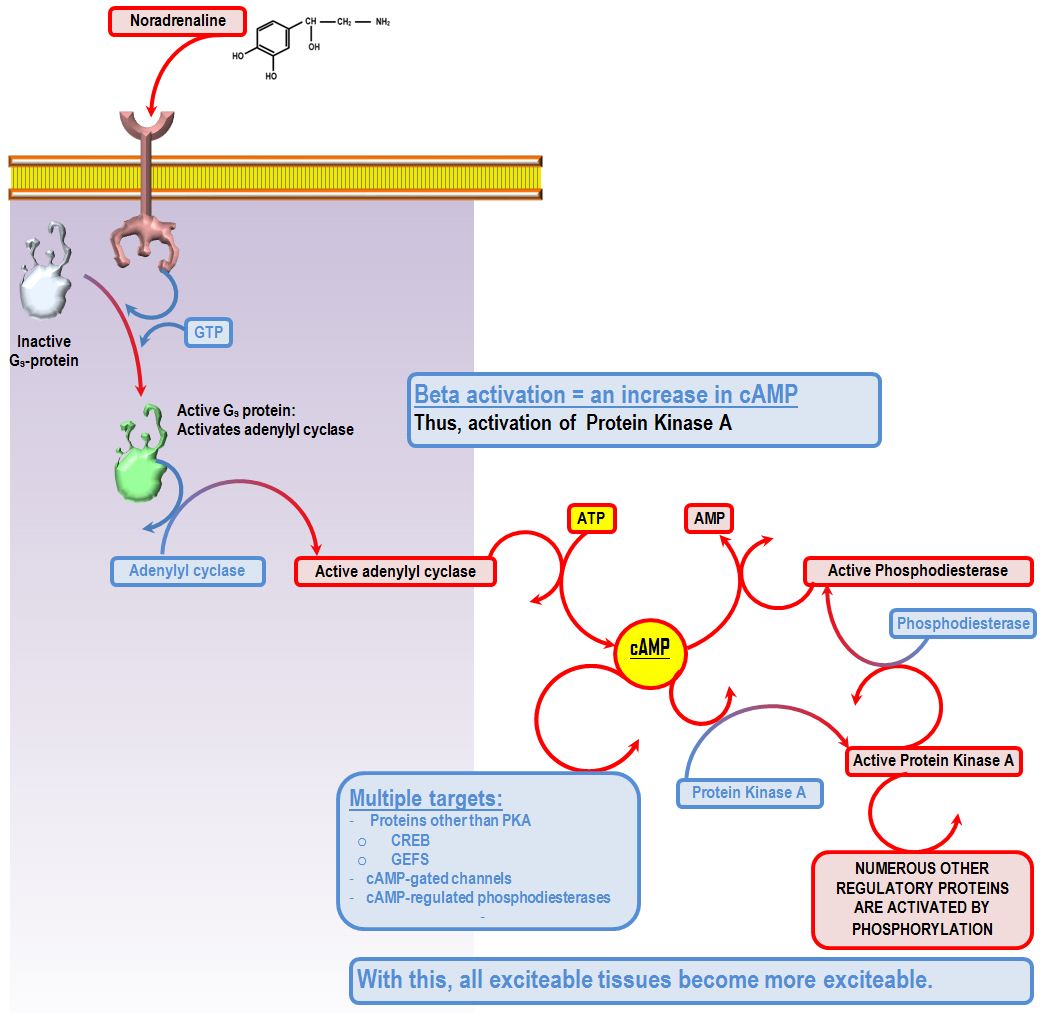
The three subtypes are mostly interesting because some of them have no interest in noradrenaline. β-1 receptors seem to have some affinity for it, but β-2 and β-3 would prefer adrenaline by a large margin. It is therefore not surprising that most of the noradrenergic nerve endings in the sympathetic nervous system face an α-receptor instead, and that β-2 and β-3 receptors are usually nonsynaptic, expressed on the surface of membranes to wait for passing adrenaline molecules.
Effects of activating β-1 receptors
These are generally viewed as the prototypic cardiac receptors, and their noncardiac effects are sufficiently few that it would be easy to remember them. Their affinity for noradrenaline is said to be approximately the same as their affinity for adrenaline, and they are typically positioned at the end of sympathetic nerve endings.
- Circulatory effects
- Increased sinoatrial node firing rate, increasing the heart rate
- Increased atrial contractility and conduction velocity
- Increased AV node automaticity and conduction velocity
- Increased His-Purkinje system automaticity and conduction velocity
- Increased ventricular contractility, conduction velocity, as well as automaticity and rate of any random idioventricular pacemakers
- Renal effects
- Increased renin secretion by the kidney
- Gastrointestinal effects
- Decreased motility and tone of the stomach
Yes, those justaglomerular effects are real- and potent β-1 agonists can produce a substantial amount of renin release. Kho et al (1980) found about 30% more renin was released during a relatively low dose (5mcg/kg/min) dobutamine infusion, and attributed some of its positive effects on blood pressure to the activation of the RAAS.
Effects of activating β-2 receptors
If the β-1 receptors are the prototypical cardiac receptors, then β-2 receptors are the prototypical smooth muscle receptors. Basically all tissues and organs that have these receptors are either not directly innervated by the sympathetic nervous system, or the innervation is α-adrenergic and mainly unrelated to whatever β-2 effects are happening. They have approximately one-tenth affinity for noradrenaline, which (to oversimplify) means that a 50ml/hr noradrenaline infusion will have the same effect on them as a 5ml/hr adrenaline infusion. The activation of these receptors results in vasodilation bronchodilation and uterine and gastrointestinal smooth muscle relaxation.
The attentive reader may at this stage revolt against the confusion resulting from calling all β-receptors "excitatory". Surely these receptors all do the same basic thing to cAMP, which is to increase it, and therefore increase the activity of the organ or tissue they are on? Would this not mean that β-2 receptors should vasoconstrict smooth muscle?
Well, yes. The cAMP pathway is almost always a road that leads to the increase in intracellular calcium availability and phosphorylation of the kind of proteins that increase contractility, which all sounds fairly excitatory. However, it is possible, through this excitation, to awaken something actively vasodilatory, and that is what seems to happen with the β-2 receptors in the peripheral circulation. One is reminded that cAMP can cause the downstream activation of all kinds of molecular machinery, some of which may give the impression of a depressant or relaxant effect. In vascular smooth muscle, increased cAMP activity leads to vasodilation by a number of mechanisms, explored in depth by Morgado et al (2012):
-
A decrease in intracellular calcium levels by the activation of calcium uptake into the sarcoplasmic reticulum and by the inhibition of its release
-
Hyperpolarization of myocytes by activation of outward potassium channels and inactivation of inward sodium Na+ channels
-
Decreasiong the sensitivity of the contractile apparatus to calcium by a decrease of the myosin light-chain kinase activity
-
Uncoupling contraction from MLC20 phosphorylation via a thin-filament regulatory process
-
Activation of the nitric oxide synthase system at the level of the endothelium (Ferro et al, 1999)
So; where Gq protein activation giveth the IP3-mediated intracellular calcium, so the Gs activation taketh it away. The reader is reminded that this is also how phosphodiesterase inhibitors exert their vasodilator effect.
Anyway. The effects of activating β-2 receptors are:
- Airway and bronchi:
- Bronchodilation
- Increased secretion of the bronchial glands
- Neurological effects:
- Relaxation of the ciliary muscle for far vision
- Modest cardiac effects: β-2 receptors make up about 25% of the total cardiac β-receptor population (Brodde et al, 2006); but whereas β-1 receptors are expressed on myocytes, β-2 receptors seem to be hanging out on fibroblasts like weirdos.
- Increased sinoatrial node firing rate, increasing the heart rate
- Increased atrial contractility and conduction velocity
- Increased AV node automaticity and conduction velocity
- Increased His-Purkinje system automaticity and conduction velocity
- Increased ventricular contractility, conduction velocity, as well as automaticity and rate of any random idioventricular pacemakers
- Vasodilation of vascular beds:
- coronary arteries
- arteries of the abdominal viscera
- renal arteries
- capacitance veins veins
- Gastrointestinal effects
- Decreased motility and tone of the stomach
- Decreased motility and tone of the intestine
- Relaxation of the gallbladder
- Relaxation of the splenic capsule
- Renal and genitourinary effects
- Relaxation of the urinary bladder
- Relaxation of the uterus
- Skeletal muscle effects
- Increased contractility of the skeletal muscle
- Increased glycogenolysis in skeletal muscle, leading to hyperlactataemia
- Increased potassium uptake into skeletal muscle (this is why salbutamol is useful in the treatment of hyperkalemia)
- Increased skeletal muscle protein synthesis; a potent myocyte/differentiation signal
- Metanbolic and endocrine effects
- Increased glycogenolysis and gluconeogenesis in the liver
- Increased the secretion of insulin
- Increased lipolysis and thermogenesis at the adipocyte
- Increased melatonin synthesis at the pineal gland
Effects of activating β-3 receptors
"Do we even need to know about these" would be a reasonable exasperated sigh of the reader who has struggled past the rest of this chapter, only to arrive at a receptor that does not have a suitably "critical care" agent associated with it. Mirabegron, the only drug used as a commercially available β-3 receptor agonist, is used to treat overactive bladder, a condition which is very unlikely to land you in the ICU. Schena & Caplan (2019) discuss the topic in greater detail than anybody could ever need to know. In the briefest possible summary, this is also a Gs-protein-coupled receptor, it has more affinity for noradrenaline than for adrenaline, and it is sufficiently different from the other isoforms that it is not affected by the usual agonists and antagonists. The main tissue and organ effects of activating these receptors include:
- Bladder (detrusor) relaxation
- Increased water and solute resorption at the kidney
- Increased lipolysis and thermogenesis at the adipocyte
- Modulation of cardiac contractility
- Relaxation of uterine contractions
References
William Tank, A., and Dona Lee Wong. "Peripheral and central effects of circulating catecholamines." Comprehensive Physiology 5.1 (2011): 1-15.
Motiejunaite, Justina, Laurence Amar, and Emmanuelle Vidal-Petiot. "Adrenergic receptors and cardiovascular effects of catecholamines." Annales D'endocrinologie. Vol. 82. No. 3-4. Elsevier Masson, 2021.
Levitzki, Alexander. "Catecholamine receptors." Reviews of Physiology, Biochemistry and Pharmacology, Volume 82 (1978): 1-26.
Ciccarelli, M., et al. "Adrenergic receptors." Endocrinology of the Heart in Health and Disease (2017): 285-315.
Strosberg, A. D. "Structure, function, and regulation of adrenergic receptors." Protein Science 2.8 (1993): 1198-1209.
Listik, Eduardo, and Qin Wang. "Alpha2-adrenergic receptors." Primer on the Autonomic Nervous System. Academic Press, 2023. 49-52.
Bylund, David B. "Alpha-and beta-adrenergic receptors: Ahlquist's landmark hypothesis of a single mediator with two receptors." American Journal of Physiology-Endocrinology and Metabolism 293.6 (2007): E1479-E1481.
Ahlquist, Raymond P. "A study of the adrenotropic receptors." American Journal of Physiology-Legacy Content 153.3 (1948): 586-600.
Humphrey, P. P. A., and E. A. Barnard. "International Union of Pharmacology. XIX. The IUPHAR receptor code: a proposal for an alphanumeric classification system." Pharmacological reviews 50.2 (1998): 271-278.
Motiejunaite, Justina, Laurence Amar, and Emmanuelle Vidal-Petiot. "Adrenergic receptors and cardiovascular effects of catecholamines." Annales D'endocrinologie. Vol. 82. No. 3-4. Elsevier Masson, 2021.
Townsend, Seth A., et al. "Critical role for the α-1B adrenergic receptor at the sympathetic neuroeffector junction." Hypertension 44.5 (2004): 776-782.
Graham, Robert M., et al. "α1-Adrenergic receptor subtypes: molecular structure, function, and signaling." Circulation research 78.5 (1996): 737-749.
Hieble, J. Paul, et al. "International Union of Pharmacology. X. Recommendation for nomenclature of alpha 1-adrenoceptors: consensus update." Pharmacological Reviews 47.2 (1995): 267-270.
Giovannitti Jr, Joseph A., Sean M. Thoms, and James J. Crawford. "Alpha-2 adrenergic receptor agonists: a review of current clinical applications." Anesthesia progress 62.1 (2015): 31-38.
Blandizzi, Corrado. "Enteric alpha-2 adrenoceptors: pathophysiological implications in functional and inflammatory bowel disorders." Neurochemistry international 51.5 (2007): 282-288.
Drouin, Candice, Ana-Clara Bobadilla, and Jean-Pol Tassin. "Norepinephrine☆." Reference module in neuroscience and biobehavioral psychology (2017).
Kho, T. L., et al. "Influence of dobutamine and dopamine on hemodynamics and plasma concentrations of noradrenaline and renin in patients with low cardiac output following acute myocardial infarction." European journal of clinical pharmacology 18 (1980): 213-217.
Brodde, Otto-Erich, Heike Bruck, and Kirsten Leineweber. "Cardiac adrenoceptors: physiological and pathophysiological relevance." Journal of pharmacological sciences 100.5 (2006): 323-337.
Ferro, Albert, et al. "Activation of nitric oxide synthase by β2‐adrenoceptors in human umbilical vein endothelium in vitro." British journal of pharmacology 126.8 (1999): 1872-1880.
Morgado, Manuel, et al. "Cyclic nucleotide-dependent relaxation pathways in vascular smooth muscle." Cellular and molecular life sciences 69 (2012): 247-266.
Schena, Giorgia, and Michael J. Caplan. "Everything you always wanted to know about β3-AR*(* but were afraid to ask)." Cells 8.4 (2019): 357.