Fraction of oxygenated haemoglobin
This chapter is most relevant to Section F8(i) from the 2023 CICM Primary Syllabus which expects the exam candidates to be able to "describe the carriage of oxygen in blood", or it could refer to Section J2(i) which is "interpret normal and abnormal blood gases". There is probably some utility in knowing about this, as many ABG machines report these variables, and knowing what they mean must have some sort of professional benefit. One might have thought that there is probably no benefit to it in terms of passing exams, as this specific narrow topic is unlikely to ever become the subject of a CICM exam question, but the examiners sprung this on us in Question 17 from the first paper of 2021, where they complained that only few of the candidates described the inability fo discriminate functional from fractional saturation as a limitation of pulse oximetry.
In the briefest summary,
- Fractional saturation (FO2Hb) is the fraction of total haemoglobin which happens to be oxygenated
- Functional saturation (sO2) is the fraction of effective haemoglobin which is oxygenated
Additionally, for broadly everyone else in the world blood gas analyser market who have not bought into the Danish Radiometer ecosystem,
- FO2Hb is the same as measured SaO2 which is the measured by the co-oximeter, i.e. the percentage of the total haemoglobin which is oxygenated. The presence of dyshaemoglobin species will decrease both the FO2Hb and the measured SaO2.
- sO2 is the same as calculated SaO2, which is computed from the measured PaO2 and pH using oxygen-haemoglobin dissociation nomograms. Both sO2 and calculated SaO2 will remain normal in the presence of dyshaemoglobin species
The discrepancy in terminology is explored below, but first:
Fraction of oxygenated haemoglobin
The fraction of oxygenated haemoglobin is a parameter that is calculated from values directly measured by absorption spectrophotometry. It is expressed as FO2Hb.
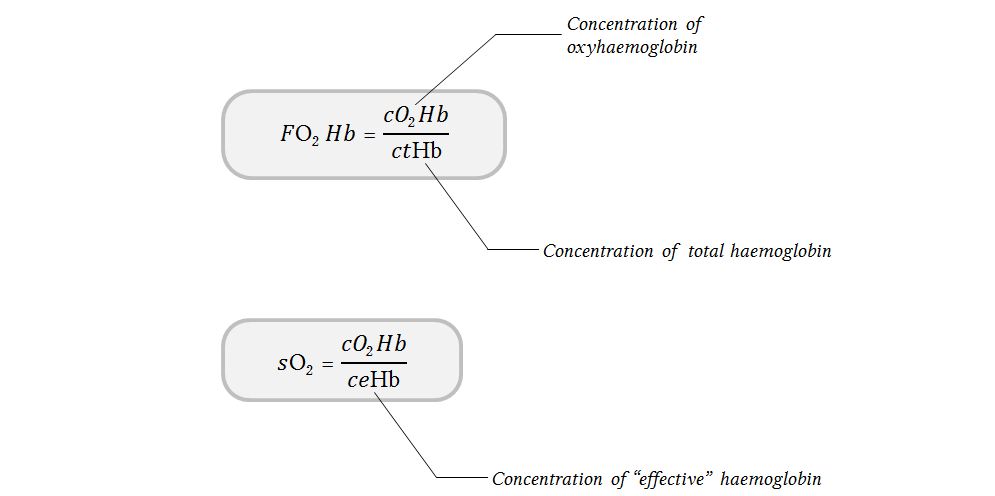
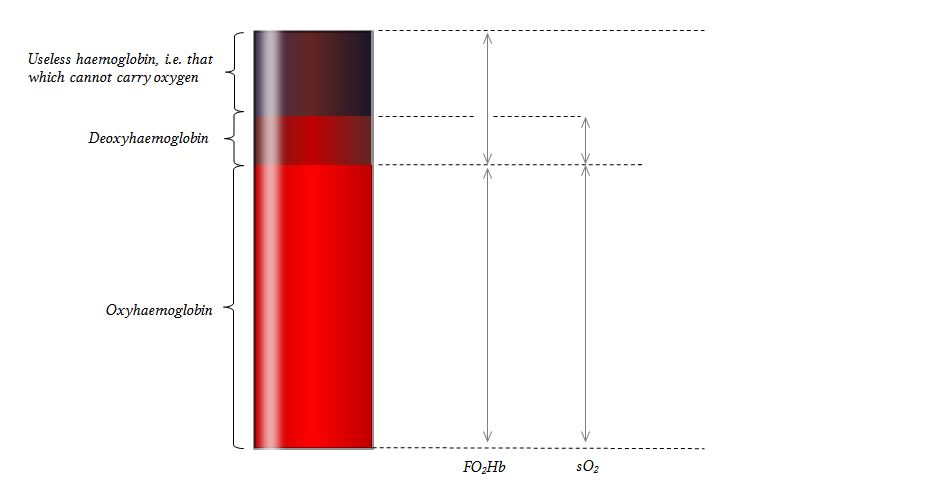
As you can see, oxygen saturation and the fraction of oxygenated haemoglobin are not interchangeable. Observe this crude diagram, which illustrates the difference between the various measures of haemoglobin oxygen content:
Functional saturation vs fractional saturation
The term "functional saturation" refers to the saturation of the haemoglobin which is capable of transporting oxygen, and corresponds to the sO2. The term "fractional saturation" refers to the fraction of total haemoglobin which happens to be oxygenated, and refers to the FO2Hb. In healthy individuals, the two values will be very similar, as these people typically have little dyshaemoglobin circulating around. However, the sO2 will be consistently a little higher, because everybody has tiny (~1%) fractions of FMetHb and FCOHb. This has implications for the estimation of the total oxygen-carrying capacity of the blood. In the presence of large concentrations of dyshaemoglobin, the sO2 will remain normal, while the actual oxygen transport will be severely impaired. The FO2Hb will accurately reflect this impairment.
What is the point of measuring this value?
Which is the more trustworthy of the two indices, FO2Hb or sO2?
The answer is that both are useful in different circumstance.
One must remember that the end goal of all these measurements is the determination of the oxygen content of the blood. If one does not have the ability to measure abnormal haemoglobin species, one is served with the ctHb value. This value represents the total haemoglobin. The FO2Hb can be used together with the total haemoglobin to calculate the total oxygen content; and one would not need to know the concentration of dyshaemoglobin species. However, one would not be able to determine the total oxygen carrying capacity in this way. For that, the sO2 would be the more relevant measure. The sO2 value excludes haemoglobins which have lack the capacity for oxygen transport (it uses oxyhaemoglobin and deoxyhaemoglobin only).
The Babylonian language crisis of O2 blood gas analysis
We are grateful for the input of Dr Larry Martin from Florida, a reader who has pointed out that many of our North American colleagues will have never encountered terms such as sO2 and the FO2Hb. Their understanding of oxygen saturation of haemoglobin would therefore be based on SaO2 and SpO2, where:
- SpO2 is measured by the pulse oximeter
- SaO2 is measured by the co-oximeter, or calculated from the measured PaO2 and pH using oxygen-haemoglobin dissociation nomograms
So, SaO2 could theoretically be two things. Measurements of SaO2 will yield a value that resembles the FO2Hb because the co-oximeter can recognise the presence of dyshaemoglobins, and will report on the total fractional saturation. On the other hand a calculated SaO2 will yield a value that resembles the sO2 because the analyser will determine the saturation purely on the basis of PaO2 and pH using a nomogram, which means it will ignore things like carboxyhaemoglobin and methaemoglobin. The education of physicians operating in this system is therefore focused on making sure that they are aware of this difference, and helping them discriminate between measured and calculated SaO2 values.
One can imagine the confusion if sO2 and FO2Hb were added into this system. There would now be five values to look at, some overlapping and some not. Attempts to standardise nomenclature have generally been driven by Severinghaus, a Dane, who of course championed a Radiometer-centric view on terminology in his "Nomenclature of oxygen saturation" (1994), and was therefore ignored. Whatever the reason, sO2 and FO2Hb are deprioritised in North American ABG interpretation teaching. They are still occasionally encountered in some literature (eg. the Open Critical Care project from the University of California and textbooks for respiratory therapists like Delost, 2014) but not in other literature (UpToDate). What is worse, among the world market leaders in blood gas analysers, there are gaping discrepancies in methodology without any corresponding difference in the names of the variables:
| Manufacturer | Saturation of effective Hb |
Saturation of total Hb |
How is the SaO2 derived? |
| Radiometer | sO2 | FO2Hb | Measured |
| Siemens | cSO2 | - | Calculated |
| GEM (Werfen) | sO2 | - | Measured |
| Nova | SO2% | - | Calculated |
| Abbott | sO2 | - | Calculated |
And the only way to determine which is which seems to require a deep dive into user manuals or manufacturer literature. The result is situations like this exchange in the pages of the American Journal of Respiratory and Critical Care Medicine, where the authors blamed the vagueness of their confusing paper on the availability of too many different types of analysers, where nobody seemed to be aware that many of the latter could not identify carbon monoxide poisoning:
"...it is more important than ever before that laboratory staff and clinicians are aware of the limitations of the different analyzers and know how to interpret results from different types of analyzers. In our 1,042-bed academic hospital, we have three blood gas analyzers with a CO-oximetry module in the central lab and 60 i-Stat POC analyzers without CO-oximetry at different departments throughout the hospital."
The aforementioned 1,042-bed academic hospital is the Utrecht University Medical Center in The Netherlands, which demonstrates that the language crisis is not unique to the United States, and calls for the involvement of IUPAC stormtroopers to manage the unruly riot of oxygenation nomenclature that bedevils our blood gas analysis. It is not too much to ask that sO2 means the same thing worldwide, as it is a fundamental concept alongside pH and PaO2, and we all seem to have agreed on how to report and interpret those.
References
Chapler, C. K., and S. M. Cain. "The physiologic reserve in oxygen carrying capacity: studies in experimental hemodilution." Canadian journal of physiology and pharmacology 64.1 (1986): 7-12.
Lifson, Nathan, et al. "The fate of utilized molecular oxygen and the source of the oxygen of respiratory carbon dioxide, studied with the aid of heavy oxygen."Journal of Biological Chemistry 180.2 (1949): 803-811.
Pittman, Roland N. Chapter 4 - Oxygen Transport; in "The Circulatory System and Oxygen Transport." (2011).
Shiao, Shyang-Yun Pamela. "Functional versus fractional oxygen saturation readings: bias and agreement using simulated solutions and adult blood."Biological research for nursing 3.4 (2002): 210-221.
Severinghaus, John W. "Nomenclature of oxygen saturation." Oxygen Transport to Tissue XV (1994): 921-923.
Delost, M. "Blood gas and critical care analyte analysis." Equipment for Respiratory Care; Volsko, TA, Chatburn, RL, El-Khatib, MF, Eds (2014).
Kemperman, Hans, et al. "Reply: Concepts of Arterial Oxygen Saturation in the Presence of Carboxyhemoglobin." American journal of respiratory and critical care medicine 188.6 (2013): 750-750.