Cardiac arrest following cardiac surgery
Cardiac arrest following cardiac surgery is surprisingly uncommon, considering the fact that the heart was already quite diseased (hence it needed the surgery) and then it has been cut, grafted, manually handled and perfused with perverse fluids. Apparently in America the rate is about 0.7-0.8%, which means in a large hospital with a minimum turnover of 200-300 post-op cardiac surgical patients you'll end up doing this at least once or twice a year. This seems consistent with local experience. Given the frequency and importance of these events, it is surprising that the college has not thought to ask about it until 2017, but then suddenly these SAQs started appearing with some regularity, and now we have several:
- Question 29 from the second paper of 2024
- Question 25 from the first paper of 2022
- Question 3 from the first paper of 2020
- Question 30.2 from the second paper of 2017
As far as reading about this for the CICM Part II exam, there is much to choose from. As usual, LITFL does it better. Just about anything published with Joel Dunning as co-author seems to be an excellent resource for this topic, but if one were pressed for time one would be wanting to limit the reading to his relatively recent 2017 consensus statement. For a definitive resource, one should read the 2015 or 2009 ERC guidelines (they did not change much).
In short, the basic differences are:
- You do not use full dose adrenaline (rather, give smaller doses)
- You do three "stacked shocks"
- You try pacing (rate of 90, DDD) in asystole if pacing wires are available
- If they are already paced and in PEA, you turn off the pacing to "unmask" VF.
- These shocks and attempted pacing are all measures you take before starting CPR, which is a departure from the ACLS norms.
- If you can't control a shockable rhythm with three stacked shocks, you give amiodarone immediately rather than after three cycles.
- Amiodarone is the only drug in the protocol, which makes it easy to remember. Atropine is mentioned in the college answer to Question 3 from the first paper of 2020, but it does not appear in the official universl alrgorithm.
- After five minutes of unsuccessful resuscitation the chest should be re-opened. External CPR is pointless in all of the common causes of arrest in this scenario. Therefore, CPR is something you do while waiting to re-open the chest.
- Non-surgical staff are encouraged to re-open the chest in an emergency.
How is post-cardiac surgery cardiac arrest different
"There is now recognition that patients having a cardiac arrest after cardiac surgery are sufficiently different from patients in general to warrant their own treatment algorithm", write Dunning et al (2017). A few key notes about what makes it so different:
- It's always "witnessed". Cardiac arrest in a cardiac surgical patient is something that happens often with not only ECG monitoring of the rhythm but likely also some combination of invasive arterial, venous and/or pulmonary arterial pressure monitoring. In short, the arresting patient has multiple systems in place to alert you to the fact that they have arrested.
- It's rarely sudden. The deterioration towards cardiac arrest usually takes the form of gradually dropping blood pressure, worsening oxygenation, deteriorating rhythm and so forth. It is very rarely something that comes out of the blue.
- There's usually no delay in diagnosis. The patient is maximally monitored; usually as soon as the rhythm degenerates into VF, it is identified by the ECG monitor and annoying alarms sound to alert you. There is no delay in checking for a pulse (the arterial line waveform is probably enough). In short, the diagnosis of cardiac arrest is made almost instantly by evaluation of advanced monitoring, rather than by a clumsy physical assessment of the deteriorated patient.
- It is usually due to an easily reversible cause. The most common causes are VF, cardiac tamponade and major bleeding: all have a ready solution. Because of this the chances of survival from cardiac arrest following cardiac surgery are good: Dunning mentions that something like 50% of these people survive to hospital discharge, which is very different to cardiac arrest from other causes.
- Re-opening the chest is the final common pathway. Of the 4 Hs and 4 Ts which are applicable, all are amenable to resternotomy.
10 days is the post-op timeframe during which you're still considered a cardiac surgical patient. Thereafter, you are still "post op" but the algorithm being followed does not end in resternotomy. This magic 10-day cut off is not completely arbitrary; rather it is based on the fact that the pericardium is going to be more difficult to access after 10 days because adhesions will form, and therefore "open resuscitation" is going to be technically more challenging. Dunning's team recommends this 10-day timeframe without offering any references in support of it; presumably the Task Force of veteran cardiothoracic surgeons did not feel they needed to provide any further justification for something so clearly within their territory.
Algorithm for managing cardiac arrest following cardiac surgery
The colourful algorithm from Dunning et al (2017) is reproduced here without permission.
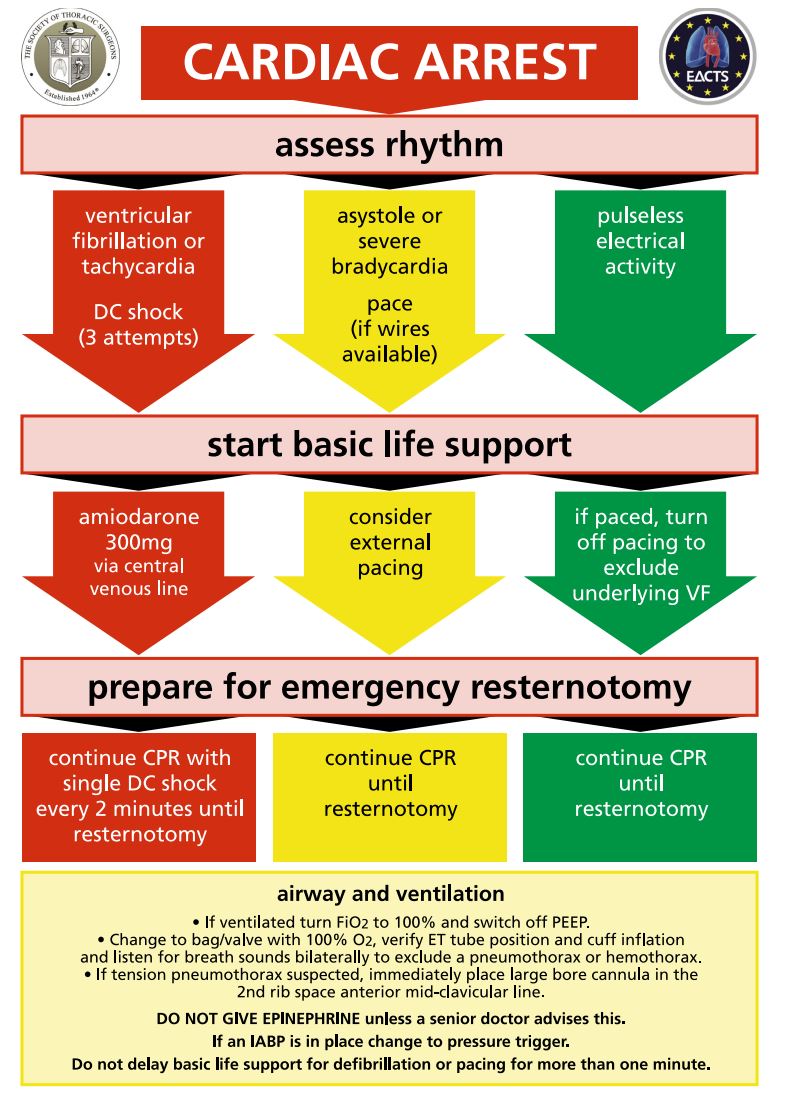
In short:
- Make the diagnosis of cardiac arrest
- All the traces (ECG, CVP, EtCO2) on the monitoring will be flat
- VF may be obvious on the monitor
- Asystole may be obvious on the monitor
- Arterial trace will be flat, or the arterial pressure will be minimal (eg. PEA)
- Call the arrest. This literally means yelling "cardiac arrest!"
- Assess the rhythm
- Make a call: is it VF, asystole or PEA?
- At this stage, you haven't started cardiac massage.
- VF: three quick shocks: the fourth only has about 10% chance of success, so after the first three you should give up.
- Asystole/bradycardia: try to pace them (most pacemakers have an emergency button, which paces at 90 with maximum amps)
- PEA: just start basic life support
- Commence BLS which essentially means external compressions.
- Assess airway and breathing. This basically means getting somebody to disconnect the patient from the ventilator and comment on the fact that it is easy to bag them (or, that it is not).
- Turn down the PEEP on the ventilator.
- Give 100% oxygen; switch to a manual bag
- Make sure trachea is midline
- Auscultate the chest to exclude pneumothorax or haemothorax.
- If there is any doubt, a large cannula in the second intercostal space (midclavicular line) rapidly removes that doubt (i.e if there was no pneumothorax before, there is definitely one now).
- External cardiac compressions have a diagnostic purpose. The arterial trace may be informative: failure to respond to external compressions may help build consensus for an early reopening (i.e it demonstrates that the pump function of the heart is somehow fatally mechanically broken, as even external massage can't seem to get blood moving).
- VF: give amiodarone
- Asystole/bradycardia: think about external pacing
- Stop all the drugs. Those sedative infusions? You don't need them. The patient is dead.
- While this is all happening, two people quietly go to the side and start gloving and gowning. Interestingly, handwashing is discouraged.
- Assess airway and breathing. This basically means getting somebody to disconnect the patient from the ventilator and comment on the fact that it is easy to bag them (or, that it is not).
- After 5 minutes of fiddling around, it's time to open the chest.
External cardiac massage after cardiac surgery
It makes logical sense, that after having spend some hours meticulously grafting little vessels to each other, one would not wish to crudely and repeatedly squish them at a rate of 100-120 times per minute. Indeed the experts all seem to agree that CPR after cardiac surgery is undesirable if it can be avoided. Fortunately, it can be avoided in a large proportion of situations:
- Shockable rhythms get three "stacked" shocks as soon as they are witnessed, and then there may be no need for CPR
- Asystole and bradycardia get pacing and if pacing gets you some cardiac output then there is no need for CPR
- The only situation which would require immediate CPR would be PEA.
Generally, CPR seems reasonably safe in this group, even with the abovementioned crude squishing. Dunning et al (2017) found large case series demonstrating the safety of CPR in this patient group. They also found case report evidence of four patients who died from massive haemorrhage due to CPR-induced trauma. These generally fall into the category of "freakish accident" or "catastrophic but unrelated to the surgery". For example, Böhrer et al (1995) had a patient whose right atrial sutures were damaged by CPR ("...After five external chest compressions, the blood loss from the drainage tubes increased enormously...Within 30 seconds, 15,00ml of blood were found to be in the collection system."). That sounds like a genuine surgery-related complication. In contrast, Kempen et al (1999) present a case of a guy whose right ventricle was ruptured by CPR following pneumonectomy, which is difficult to blame on the post-cardiac-surgical state because that ventricle was never operated upon pre-arrest. Similarly, Kim et al (2007) present a case of a post-pneumonectomy patient whose left ventricle was ruptured by CPR, again an inexplicable and possibly unrelated complication given the fact that the surgeons never touched the cardiac muscle.
In summary, CPR in cardiac arrest following cardiac surgery is fortunately often avoidable, but one should not be afraid to start compressions it if the situation calls for it. The monitors will give ample feedback for efficacy of compressions; Dunning et al recommend a systolic blood pressure of 60mmHg as a sensible target. If compressions are not achieving this target, there is likely cardiac tamponade and all efforts should be directed to getting the chest re-opened as soon as possible.
Pacing in cardiac arrest following cardiac surgery
These paients often have pacing wires. If they are bradycardiac or asystolic, you can try to get cardiac output back by using the pacemaker. The recommended settings are:
- Dual chamber
- Asynchronous mode
- Maximum output (mA)
- Rate of 80-100
A paced PEA may occasionally be VF in disguise; the pacemaker spikes and whatever ventricular electrical behaviour follows them can obscure the fine erratic waveform of ventricvular fibrillation. In PEA, Dunning et al recommend to turn off the pacemaker to interrogate the underlying PEA rhythm.
Adrenaline dose in cardiac arrest following cardiac surgery
In general, the use of adrenaline (or any inotrope or vasopressor for that matter) has never been firmly associated with an improvement in survival. We give these drugs as a part of the death ritual, but it is not supported by anything more scientific than the opinions of well-meaning experts. Studies do suggest that there is some improvement in the rate of return to spontaneous circulation, which is not really a patient-centered outcome.
Specifically, the use of adrenaline in cardiac arrest following cardiac surgery has some serious problems associated with it. In short, whatever the cause of their arrest, the patient is likely to return to spontaneous circulation quite soon, and the main way that will happen is through the liberal use of electricity- whether by defibrillation or by pacing. The blood pressure and cardiac output will therefore be restored to their previous values (presumably, they were doing fine without massive doses of adrenaline before they arrested). Ergo, giving a massive dose of adrenaline to the briefly pulseless patient will result in their spontaneous circulation returning with a furious vengeance: the blood pressure will hit "patent pending". Interestingly, the locally available arterial pressure transducer maxes out at 300mmHg, for no hard engineering reasons but reasoning logically that the clinical differences between a systolic of 300 and a systolic of 400 are largely academic.
Anyway. This post-ROSC blood pressure spike has disastrous consequences for the delicate anastomoses fashioned by the surgical team. The overpressured coronary grafts will break their sutures and hose arterial blood into the pericardial cavity. Hilarity will ensue. Stephen Webb's open letter to the European Resuscitation Council (2008) describes this as "catastrophic disruption at surgical sites" and cautiously recommends the use of adrenaline doses lower than 100mcg per bolus. In the 2017 consensus statement, Dunning's task force starts their dose range with 50 mcg.
In summary, the role of adrenaline in cardiac arrest following cardiac surgery is probably limited to specific indications like anaphylaxis, and to maintaining blood pressure in peri-arrest states.
Three DC shocks in cardiac arrest following cardiac surgery
After reading just about everything there was to read about DC shocks following cardiac surgery, Dunning Richardson and Dissanayake (2007) came to the conclusion that three is the magic number. Not four; not two. Why, one might ask? Apparently when the success rates for all reported defibrillation attempts are summed, one finds the following pattern:
- First shock: 78% chance of success
- Second shock: 35% chance of success
- Third shock: 14% chance of success
- Fourth and all subsequent shocks: laughably miniscule chance of success
Following from this, it would be preferable to start preparations for the re-opening of the chest instead of mindlessly shocking the patient more and more times.
Amiodarone in cardiac arrest following cardiac surgery
One might notice that the algorithm response to three failed DC shocks is 300mg of amiodarone. The recommendation to do this (as opposed to any other thing) is based on Leeuwenburgh et al (2008), whose literature search yielded mainly pre-hospital data and expert opinion. It is another thing we do which has limited scientific basis but which is generally felt to be harmless if not beneficial.
Atropine
In their answer to Question 30.2 from the second paper of 2017, atropine was mentioned by the examiners as one of the drugs used in the routine management of the patient in "extreme bradycardia, asystole". In fact, one should not have really mentioned in in that answer, because the question asked for us to "outline the modifications to the standard adult ALS algorithm", and atropine actually is not one of those modifications. At least, it does not appear in the official algorithm. To quote the 2017 Dunning consensus paper:
"We were unable to find any further evidence in favor of atropine in the cardiac surgical literature. It is also not advocated in the universal algorithm, and our expert consensus group believed that a cardiac arrest due to bradycardia or asystole would ideally be treated with pacing and that atropine administration would only create delay. "
Adjunctive matters
Apart from hot and sexy strategies like opening the chest, there are several other steps which need to be taken, and which contribute to some minor degree towards the overall goal of ongoing patient survival. These are:
- Take the patient off the ventilator and manually ventilated them
- Increase the FiO2 to 100%
- Drop the PEEP to zero, to optimise preload
- Obviously, exclude a tension pneumothorax. It would be embarrassing to perform a resternotomy for a tension pneumothorax.
- Stop the sedating infusions. With diminished cerebral perfusion, the chances of awareness are pretty minimal. In fact, stop all the infusion (to prevent drug errors).
- Switch the IABP to pressure trigger mode (that way it assists CPR)
Re-opening the chest
Dunning et al (2017) recommend the preparations for this should take place immediately as the arrest is identified, rather than waiting until conservative measures have failed. It appears that making the decision early favours improved survival. Mackay et al (2002) found that reopening the chest within 10 minutes was associated with a survival of 48% (not bad for cardiac arrest), whereas after 10 minutes the survival was 12%. Pottle et al (2002) cut that down to an even shorter timeframe of 5 minutes. In short, there should be no hesitation wounds. One should embark upon the resuscitation of such a patient with the clear expectation that the chest is going to be reopened imminently.
Only five items are essential:
- Scalpel
- Wire cutter
- Heavy needle holder
- Sternal retractor
- Sucker
That's all you need, even though the tray contains over thirty pieces.
The technique is as follows:
- Get two friends. Most of the time this is a three-person job
- Forget handwashing. Get into the gown and use a closed-sleeve gloving technique to minimise infection risk.
- Set up your instrument tray.
- Ask the team to stop CPR and quickly remove the sternal dressing
- Squirt the chest with some antiseptic. Ideally, povidone iodine.
- Apply the drape.
- Restart CPR with gowned personnel.
- Cut through the same incision down to sternal wires using the scalpel
- Cut the sternal wires with the wire cutters and use the heavy needle holder to pull them out. This works faster if one person cuts and the other person pulls.
- Suck out the clot. The sternal edges may part enough to relieve some of the tamponade and to give some access.
- Open the sternum using the sternal retractor. If you have cardiac output, fist bump with your gowned assistant. If not, look for a bleeder to clamp, commence open cardiac massage and / or internal defibrillation.
Though everybody in the care team should be trained to do this, realistically things work a lot better if there is a specific person who is nominated as the official "chest opener". This could be a nurse, a surgeon, a non-surgical doctor, essentially anybody. The main thing is the "officially nominated" part. Everybody on the shift should be aware that this role is covered.
The chest is open again. Now what?
With the sternum reopened and the heart still in arrest, one may suddenly be confronted with the realisation that one is not a cardiac surgeon, and therefore has no idea how to find the underlying problem and fix it. Fortunately, there are only a few recommended manoeuvres. One should suck out whatever clot is visible, put pressure on anything that's bleeding, and perform internal cardiac massage.
Internal cardiac massage. Twomey et al (2008) performed a thorough literature search on this topic and found that usually cardiac output more than doubles when you compare internal and external cardiac massage. The often-quoted numbers are a cardiac index of 0.6L/min/m2 externally and 1.3L/min/m2 internally. Clearly that is a massive haemodynamic benefit. More pragmatically, one hardly needs to point out that with the chest already open, one doesn't exactly have the option of external cardiac compressions.
So, how do you do it? Few people undergo any sort of formal training. However, this was the thing to do for cardiac arrest before the less messy technique of external massage took over in the 1960s. Stephenson et al (1953) published a case series of 1200 patients who underwent open cardiac massage for cardiac arrest of any cause. The image below is taken from that paper; it illustrates the technique used to perform open cardiac massage in a patient without a convenient sternotomy wound.
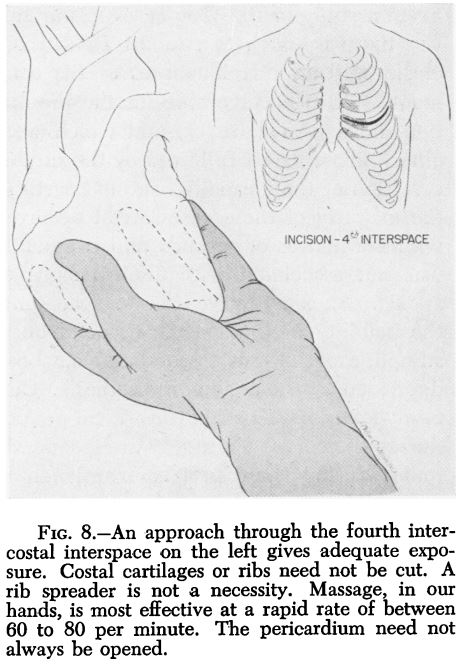 In short, there are a few different techniques. The best resource for these seems to be anything published by H.E Stephenson Jr; after the 1953 paper quoted above he went on to become a doyen of open cardiac massage, with an illustrious career spanning some decades. His 1985 chapter for Emergency and Disaster Medicine is a definitive resource on the subject.
The best method is probably the two-handed technique (best in terms of minimising injuries and creating the greatest haemodynamic benefit). You hold the heart in both hands (it is best to stand on the patient's left side for this). The right hand goes under the heart, and the left goes over it. Your wrists should be at the apex of the left ventricle. Your palms and fingers should be straight. The compressions should be carried out with a "clapping" motion so that the wave of compression progresses from apex to base. One must take care to keep the fingers flat: if you dig them into the cardiac tissue you can easily tear the atria.
Another method is a one-handed compression technique, where you compress the heart against the rib cage or vertebral column. This requires the least access (i.e. it can be performed with a smallish sternotomy) but one might make the argument that the chest is already open and to widen the sternotomy so as to facilitate effective CPR is not a massive inconvenience. An alternative method unrelated to post-op cardiac surgery is to access the chest through a subxiphoid incision, where one may compress the heart upwards against the intact sternum.
The third method is the one-handed squeeze technique, illustrated in the image from Stephenson et al. This is where you hold the heart with one hand and use the thumb and palm to compress the LV. This can perforate the LV and has the least haemodynamic benefit in terms of cardiac output. One occasionally resorts to this when one has performed a left thoracotomy for cardiac arrest from penetrating chest injury (because there is insufficient access for the other techniques). In cardiac arrest, the right ventricle will be distended and thin; it is very easy to perforate it even when being very careful.
That was ...not a very sterile procedure. Should I give antibiotics? Good question. Apparently, everybody does. Dunning et al (2017) found that this practice of giving antibiotics following emergency resternotomy was in place without any evidence to back it. The task force concluded that it was "reasonable" to do this. In essence, not giving antibiotics therefore ends up being in contrary to best practice.
References
Dunning, Joel, et al. "The Society of Thoracic Surgeons Expert Consensus for the Resuscitation of Patients Who Arrest After Cardiac Surgery." The Annals of Thoracic Surgery103.3 (2017): 1005-1020.
Dunning, Joel, et al. "Guideline for resuscitation in cardiac arrest after cardiac surgery." European Journal of Cardio-Thoracic Surgery 36.1 (2009): 3-28.
Neumar, Robert W., et al. "Part 1: Executive Summary." Circulation 132.18 suppl 2 (2015): S315-S367.
Truhlář, Anatolij, et al. "European resuscitation council guidelines for resuscitation 2015." Resuscitation 95 (2015): 148-201.
Böhrer, H., R. Gust, and B. W. Böttiger. "Cardiopulmonary resuscitation after cardiac surgery." Journal of cardiothoracic and vascular anesthesia 9.3 (1995): 352.
Kempen, Paul Martin, and Richard Allgood. "Right ventricular rupture during closed-chest cardiopulmonary resuscitation after pneumonectomy with pericardiotomy: a case report." Critical care medicine 27.7 (1999): 1378-1379.
Kim, Heung Ki, et al. "Left Ventricular Rupture during Closed-chest Cardiopulmonary Resuscitation after Pneumonectomy-A case report." Korean Journal of Anesthesiology 53.1 (2007): 123-126.
Richardson, Lydia, Arosha Dissanayake, and Joel Dunning. "What cardioversion protocol for ventricular fibrillation should be followed for patients who arrest shortly post-cardiac surgery?." Interactive cardiovascular and thoracic surgery 6.6 (2007): 799-805.
Webb ST. "Caution in the administration of adrenaline in cardiac arrest following cardiac surgery." Resuscitation 2008;78:101.
Leeuwenburgh, Boudewijn PJ, et al. "Should amiodarone or lidocaine be given to patients who arrest after cardiac surgery and fail to cardiovert from ventricular fibrillation?." Interactive cardiovascular and thoracic surgery 7.6 (2008): 1148-1151.
Twomey, Darragh, et al. "Is internal massage superior to external massage for patients suffering a cardiac arrest after cardiac surgery?." Interactive cardiovascular and thoracic surgery 7.1 (2008): 151-157.
Vallejo-Manzur, Federico, et al. "Moritz Schiff and the history of open-chest cardiac massage." Resuscitation 53.1 (2002): 3-5.
Stephenson Jr, Hugh E., L. Corsan Reid, and J. William Hinton. "Some common denominators in 1200 cases of cardiac arrest." Annals of surgery 137.5 (1953): 731.
Stephenson Jr, H. E. "Open-Chest Cardiopulmonary Resuscitation." Emergency and Disaster Medicine. Springer Berlin Heidelberg, 1985. 373-377.
Mackay, J. H., et al. "Six-year prospective audit of chest reopening after cardiac arrest." European journal of cardio-thoracic surgery 22.3 (2002): 421-425.
Pottle, A., et al. "Survival to discharge following open chest cardiac compression (OCCC). A 4-year retrospective audit in a cardiothoracic specialist centre—Royal Brompton and Harefield NHS Trust, United Kingdom." Resuscitation 52.3 (2002): 269-272.