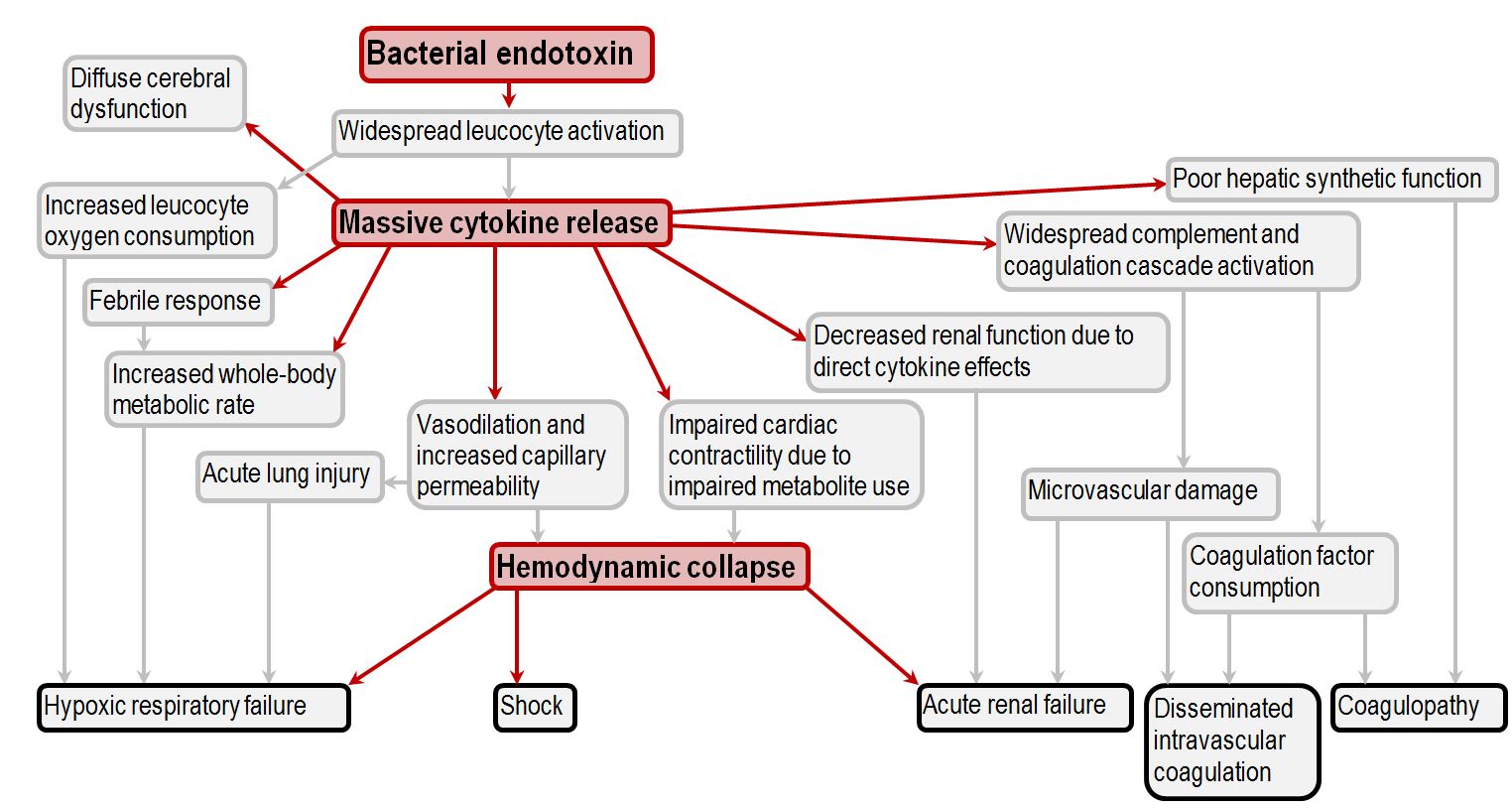
Multiple organ dysfunction syndrome, the horrifying spiral that puts the "intensive" in "intensive care", has for some reason found its way into Section 2.1.8 from the second edition of the CICM Syllabus for the Second Part Examination, even though there are non-infectious ways to enter this final common pathway. It has never appeared in the exams by name.
The search string "multiple organ dysfunction syndrome" yields about ten articles at the top of the Google Scholar results, all of them titled "Multiple organ dysfunction syndrome". Ziesmann & Marshall (2018) or Marshall & Deutschman (2021) are strong contenders.
Prior to the modern era of enlightenment, the savages had referred to this as "multiorgan system failure", which was dismissed from the vernacular presumably because it was too pejorative and discouraging. "Failure" implies some moral fault on the part of the liver and kidneys, as if they abandoned their duties because of some fundamental defect of their character, a lack of discipline or proper moral fibre. Perhaps "multiple organ predicament syndrome" would be better, because it implies that the organs are doing it tough in a difficult situation. "Peril", "woe" and "mischance" were also on the menu, but Arthur Baue chose "failure" when he first coined the term in 1975. "Multiple systems failure", "progressive systems failure" and "sequential systems failure" were also known in the literature, but were being used unsystematically. The novel observation made by Baue was that on autopsy, "the same combination of problems is seen in many patients with very different primary diagnoses". This was the final common pathway. "If the primary diagnosis or problem is eliminated, these autopsy reports look much the same."
That this would have been seen so frequently in the 1970s is not surprising considering everything we know about their approach to organ system support. The term "failure" is probably less applicable to modern day Intensive Care, as these days our patient's organs have a tendency to recover, which implies that "dysfunction" is a more accurate way to phrase it. "Failure" is "a dichotomous event that is either present or absent", whereas dysfunction is a continuum, argued a council of elders (1992), describing the decision to define MODS along with sepsis and SIRS. Dysfunction, they argued, "identifies this process as a phenomenon in which organ function is not capable of maintaining homeostasis", which is somehow different to failure. On the basis of this reasoning, these illuminati proclaimed a definition,
MODS is "...presence of altered organ function in an acutely ill patient such that homeostasis cannot be maintained without intervention"
So is this the short pithy statement which the CICM exam candidates should memorise? Unfortunately not. This definition did not persists in the subsequent iterations of the consensus sepsis definitions, mostly because those aimed "to provide a conceptual and a practical framework" for clinicians and researchers, whereas MODS as defined above did none of that. For one, "altered function" opens the definition to the possibility of improved function, and beyond that, it leaves us to establish ourselves what homeostasis is, and how to decide whether it is being maintained. In short, there is nothing official to memorise, because the syndrome, though widely recognised as A Real Thing, remains without a standardised description. Even Oh's Manual (8th ed) has nothing except this, from the chapter on MODS from Maiden & Chapman (2018):
MODS is "... is a complex process whereby an acute disease precipitates deranged function of a number of organ systems"
Perhaps JC Marshall said it best:
"the development of potentially reversible physiologic derangement involving two or more organ systems not involved in the disorder that resulted in ICU admission, and arising in the wake of a potentially life-threatening physiologic insult."
An insane flow chart used to occupy this space, but it was banished, because even a casual inspection of the shape of it suggested that it could not possibly serve to inform anybody about anything. Because everything is interconnected anyway, there is no point drawing arrows from each factor to each factor (but Oh's manual did this anyway). Perhaps a better method would be to list causes and consequences in several disconnected lists. Ziesmann & Marshall (2018) do this much better and in more detail:
BAUE, ARTHUR E. "Multiple, progressive, or sequential systems failure: a syndrome of the 1970s." Archives of Surgery 110.7 (1975): 779-781.
Marshall, John C., and Clifford S. Deutschman. "The multiple organ dysfunction syndrome: syndrome, metaphor, and unsolved clinical challenge." Critical Care Medicine 49.9 (2021): 1402-1413.
Gourd, Nicholas M., and Nikitas Nikitas. "Multiple organ dysfunction syndrome." Journal of intensive care medicine 35.12 (2020): 1564-1575.
Proulx, François, et al. "Multiple organ dysfunction syndrome." Pediatric Critical Care Medicine: Volume 1: Care of the Critically Ill or Injured Child (2014): 457-473.
Maiden, Matthew J., and Marianne J. Chapman. "Multiorgan dysfunction syndrome." Oh's Intensive Care Manual E-Book: Oh's Intensive Care Manual E-Book (2018): 150.
Bone, Roger C., et al. "Definitions for sepsis and organ failure and guidelines for the use of innovative therapies in sepsis." Chest 101.6 (1992): 1644-1655.
Levy, Mitchell M., et al. "2001 sccm/esicm/accp/ats/sis international sepsis definitions conference." Critical care medicine 31.4 (2003): 1250-1256.