Cardiac failure in pregnancy
Cardiac failure in pregnancy is a common enough reason for ICU admission, and is worth knowing about for exam purposes as well as in real life terms. Very likely neither the obstetrician nor the cardiologist get as much exposure to this condition as the intensivist is going to get during their career. As the most interesting part of peripartum cardiomyopathy is its association with pregnancy, this chapter got shoved into the O&G section (whereas the cardiomyopathy aspect of it is a fairly boring one, and generic with a lot of other management of heart failure).
Though rarely, this does tend to come up in the exams. Question 28 from the first paper of 2017 asked specifically for diagnostic ciriteria of peripartum cardiomyopathy, which are discussed below. Question 16 from the second paper of 2010 asked specifically for pregnancy-associated causes of left and right heart failure in pregnancy, which was tricky because not all of the possible causes of heart failure in pregnancy are related to the pregnancy itself. For instance, a fair proportion of girls with congenital heart disease are cared for so well these days that they grow up into women, and then go on to get pregnant. The college answer to that question actually cheated by including such things as PE, which is not a strictly pregnancy-associated issue - but is common enough to warrant discussion in this context. Lastly, Question 15 from the second paper of 2021 asked about how one might go about managing these pregnancy-associated cardiac failure states. A brief discussion of the important issues is offered below. Wherever possible, juicyness of detail was sacrificed to brevity and precision.
Causes of heart failure in pregnancy
This works best as a table. In fact, in Sliwa et al (2010) there is an even better table (Table 3. p.772)
| Left-dominant | Right-dominant |
|
|
|
Potentially bi-ventricular:
|
|
Peripartum cardiomyopathy
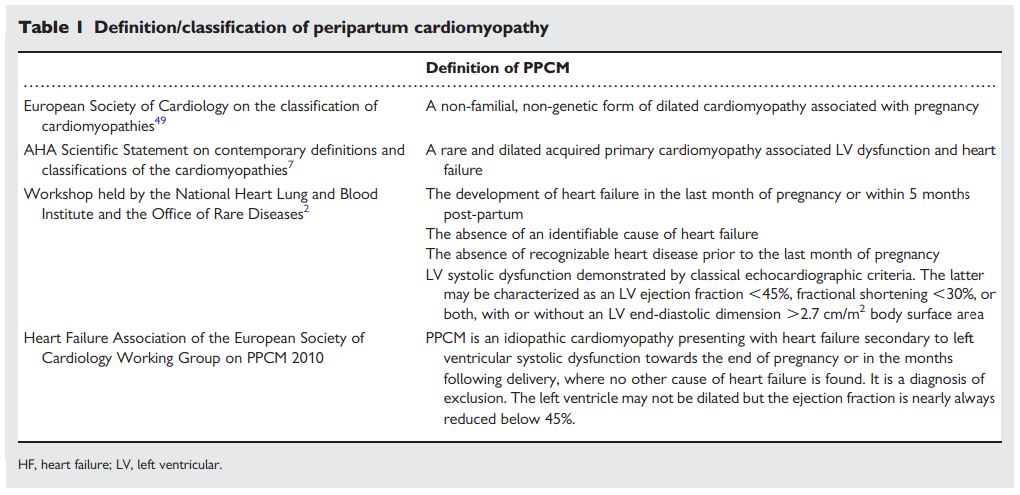
Question 28 from the first paper of 2017 asked for a specific definition of this disease, which is weird because it does not seem to have a widely agreed-upon definition. The ESC statement from 2010 (Sliwa et al) offers the following criteria for diagnosis:
- Failure in the end of pregnancy, or in the following few months
- No other explanation (diagnosis of exclusion)
Is this meaningful? Of course not. The pragmatic intensivist would spit with derision at the very idea. There are no specific treatments to offer, for PPCM or for most other aetiologies of acute heart failure; and the non-specific management is exactly the same for all of them. So what does it matter what the diagnosis is?
Well, it certainly matters when 30% of a CICM SAQ asks you to "list the diagnostic criteria for peri-partum cardiomyopathy". The college answer to this question is available, and is therefore canonic - the definitive diagnostic criteria, no matter what the wold literature says. These diagnostic criteria are as follows:
- Onset of heart failure in the last month of pregnancy or within 5 months post-partum
- Absence of an identifiable cause of heart failure
- Absence of recognizable heart disease prior to the last month of pregnancy
- LV systolic dysfunction demonstrated by classical echocardiographic criteria. The latter may be characterized as an LV ejection fraction < 45%, fractional shortening < 30%, or both, with or without an LV end-diastolic dimension 2.7 cm/m2 body surface area.
"This level of detail not expected", the college allows generously at their end of their ultra-detailed highly specific answer. So, that is fine. But where did they get their details from? Well. If the candidate selects their entire LV echocardiographic criteria and uses it as a Google search string, several prominent textbooks of cardiology pop up. One such book is Volume 1 of Management of Heart Failure by Baliga and Haas. In fact there one may find the college answer in completely unchanged verbatim copy. Unlike the college answer, Baliga and Haas use responsible referencing, and offer us an explanation as to where these criteria came from. They were concocted by a panel of fourteen experts during a conference workshop (Pearson et al, 2000).
In actual fact there are several competing definitions, of which the abovementioned one is probably the least vague. Observe (from the same article):
Characteristic features of peripartum cardiomyopathy (also from Sliwa et al):
- It is usually a postpartum process: only 9% present antepartum. NHL-BIOR definition calls it PPCM if it is one month before or five months after delivery, but the ESC people felt this (totally arbitrary) timeframe would lead to underdiagnosis.
- There is mainly LV dysfunction
- The LV is usually dilated (if it is dilated beyond 60mm, the chances of recovery are small)
- It usually gets better: An estimated 23%-54% of patients show complete recovery of their systolic function within 6 months.
Pathophysiology? Who the hell knows. Certainly not these guys. Possibilities which have been considered:
- Nutritional deficiencies (eg, selenium)
- Prolactin (cleaved into a 16-kDa pro-apoptotic subfragment)
- Inflammatory changes in the myocardium
- Auto-antibodies to cardiac tissue
- Genetic susceptibility
Management is same as you would manage acute heart failure from any cause:
- Management of preload
- Diuretics
- Fluid restriction
- Venodilators
- Aldosterone agonists
- Beta-blockers
- Maintenance of sinus rhythm and atrial systolic contribution
- Pacing to maintain AV synchrony
- Management of afterload
- Left ventricle
- Vasodilators
- ACE-inhibitors
- Beta-blockers
- Right ventricle
- Normoxia
- Normocapnea
- Avoidance of excessive postive respiratory pressures
- Pulmonary vasodilators
- Left ventricle
- Management of contractility
- Inotropes
- Digoxin
- Dobutamine
- Milrinone
- Levosimendan
- Cardiac resychronisation
- Supportive hormones and micronutrients (cortisol, insulin, calcium, glucagon, thyroxine, thiamine etc)
- Inotropes
- Cheating
- Increase cardiac output by unnatural means:
- LVAD
- ECMO
- Increase the pacemaker rate
- Decrease the organism's demand for cardiac output
- Hypothermia
- Paralysis/sedation
- Increase cardiac output by unnatural means:
A large selection of the drugs which you would normally use are contraindicated during pregnancy, for example:
- ACE inhibitors
- Angiotensin receptor blockers
- Spironolactone
- Nitroprusside
Experimental techniques specific to PPCM:
- Pentoxifylline, an anti-inflammatory agent has been tried - after all, it's supposed to be an inflammatory state.
- Bromocriptine has been tried - prolactin is implicated, after all - and it is interesting enough to have stimulated an RCT (Haghikia et al, 2015)
Specific issues in PPCM:
- Anticoagulation: you need it because they are prothrombotic, and LV clots tend to form in the big flaccid ventricle. Corriveau et al (2014)
- Need for cardiac transplant: yes, over 50% recover their LV function, but what of those who do not? Cardiac transplant outcomes are no worse for this group than for women being transplanted for other non-pregnancy-related reasons (Rasmusson et al, 2007).
- Corticosteroids - not for the mother (as immunosuppression has no benefit in PPCM) but for foetal lung maturation
- Planning of delivery: the more severe the haemodynamic disturbance, the more urgen the caesarian (as one should want to improve preload by decompressing the gravid uterus, as well as to protect the child from gestating inside a hypotensive hypoxic host).
- Do not breastfeed. Especially if the prolactin hypothesis is to be believed.
- Never get pregnant again. Especially if the LV has never completely normalised.
Tocolytic-associated pulmonary oedema
Pisani et al (1988) desribe this condition which is fairly rare these days. In the 1980s, tocolytic therapies had consisted of beta-agonists such as terbutaline, isoxsuprine, ritodrine, and salbutamol. Pregnant women develop pulmonary oedema in association with the use of these agents, whereas non-pregnant women do not. This is because of several factors (see this discussion by R.F Lamont, 2000), some of which change the variables of the Starling equation:
- Increased fluid volume
- Increased capillary hydrostatic pressure
- Decreased plasma oncotic pressure
- Tachycardia, with diastolic failure due to decreased filling time
- hypokalemia, which gives rise to low-output arrhythmias
Predictably, management consists of stopping the offensive tocolytic agent, or - like most modern O&G services - by eschewing the use of these primitive methods. In this day's kingdom of reason, we prefer to use nifedipine.
References
Chapter 64 (pp. 684) General obstetric emergencies by Winnie TP Wan and Tony Gin
Chapter 65 (pp. 692) Severe pre-existing disease in pregnancy by Jeremy P Campbell and Steve M Yentis
Sliwa, Karen, et al. "Current state of knowledge on aetiology, diagnosis, management, and therapy of peripartum cardiomyopathy: a position statement from the Heart Failure Association of the European Society of Cardiology Working Group on peripartum cardiomyopathy." European journal of heart failure 12.8 (2010): 767-778.
Rasmusson, Kismet D., et al. "Long-term outcomes of cardiac transplantation for peri-partum cardiomyopathy: a multiinstitutional analysis." The Journal of Heart and Lung Transplantation 26.11 (2007): 1097-1104.
Sliwa, Karen, James Fett, and Uri Elkayam. "Peripartum cardiomyopathy." The Lancet 368.9536 (2006): 687-693.
Haghikia, Arash, et al. "Rationale and design of a randomized, controlled multicentre clinical trial to evaluate the effect of bromocriptine on left ventricular function in women with peripartum cardiomyopathy." Clinical Research in Cardiology 104.11 (2015): 911-917.
Corriveau, Sophie, Mohan Cooray, and Jim Douketis. "To thin or not to thin: a case of peripartum cardiomyopathy." Canadian Journal of Cardiology 30.7 (2014): 835-e1.
Pisani, Richard J., and Edward C. Rosenow. "Pulmonary edema associated with tocolytic therapy." Annals of internal medicine 110.9 (1989): 714-718.
Lamont, R. F. "The pathophysiology of pulmonary oedema with the use of beta‐agonists." BJOG: An International Journal of Obstetrics & Gynaecology 107.4 (2000): 439-444.
Pearson, Gail D., et al. "Peripartum cardiomyopathy: national heart, lung, and blood institute and office of rare diseases (national institutes of health) workshop recommendations and review." Jama 283.9 (2000): 1183-1188.