Videolaryngoscopy
In the field of airway management, no topic is more divisive than the merits of videolaryngoscopy. Proponents defend the technology and opponents assail it with equally valid arguments, and the differences in opinion are not purely ideological. These devices and techniques have their advantages and disadvantages. This belongs in the "Airway management" syllabus item, a Narnia in the middle of Section 2.1.5 which is otherwise concerned with respiratory medicine, from the second edition of the CICM Syllabus for the Second Part Examination. This is an L1 "topic" item, and so the candidates are expected to know "relevant anatomy, principles and practice, interpretation, relevant guidelines and evidence, controversies and risks". Where possible, this format will be adhered to here, whether it works or not.
In summary, a comparison of video and direct laryngoscopy, with a focus on technique:
| Aspect | Videolaryngoscopy | Direct laryngoscopy |
| Logistics and technology |
An extra device in a busy room. Requires a powerpoint or battery. Multitudes of devices - hard to standardise training for them all. |
Small and unimposing. Requires no power source. Devices are uniform in shape and performance. |
| Technique | "Look down, look up, look down, look up"- the technique calls for changing attention between the airway and the screen | Relies on the alignment of axis to achieve line of sight of the glottis |
| Indication |
Improve first pass success rates in routine intubation Rescue failed direct attempts with DL First line for anticipated difficult airway |
High volume use environment with experienced operators (eg. operating theatres) - batch-sterilising metal DL blades may be more economical than using single-use blades for VL, saving equipment costs |
| View | Improved view over DL - 96% were Grade 1, vs. 6%, in Foulds et al (2016) | For many patients and for experienced operators, view may be noninferior to DL |
| First pass success rate |
DEVICE trial: 85.1% success rate No difference in MACMAN trial |
DEVICE trial: 70.8% success rate No difference in MACMAN trial |
| Complications |
Laryngeal injury reduced Oesophageal intubation reduced Dental injury same Palatine injury may be increased Increased distance from the airway results in less infectious risk for the operator |
Rates of intubation related complications prior to VL were already low with DL Increased exposure of the operator to exhaled patient pathogens, eg. COVID |
| Teaching |
Easier to demonstrate anatomy and technique to onlookers |
Manufacturers all produce very similar devices. Easy to standardise teaching. |
| Supervision |
Shared mental model of the team Supervision of junior trainees is made easier |
Relies on clear communication between the operator and supervisor |
| Evidence | ||
For published literature on this subject, there are several good references. LITFL have a good overview of videolaryngoscopy. The 2014 article by Chemsian et al actually has an "advantages and disadvantages" section, which directly answers Question 19. Norris and Heidegger (2016) discuss the limitations of videolaryngoscopy in their BJA editorial.
Relevant anatomy of videolaryngoscopy
Turning the "expected knowledge" recommended for this topic sideways, one might assert that the most relevant anatomy for the CICM Second Part exam candidate would be the anatomy of the videolaryngoscope itself, the anatomy of the glottis having been covered in the First Part exam. There are, unfortunately, too many morphological variants to speak of. If laryngoscopes were an organism, the mid-noughties represented some kind of Cambrian Explosion of these devices, facilitated by the increased availability of cheap high-performance cameras and monitors. Karalapillai et al (2014) describes the big names from the earlier era, back when the number of species was manageable (CMAC, the McGraths, Glidescope, Pentax, Airtraq), but these days this would be an insurmountable task. A quick google reveales no less than 163 products from 57 companies, just from one medical expo. Fortunately, selection pressure is present in all ecosystems (the market is red in tooth and claw), which means some of these devices have since become extinct (for example, the King Vision is discontinued as of 2025). Carrying on with this ridiculous biological metaphor, the following phylogenetic tree can be crudely assembled to showcase the most common phenotypes:
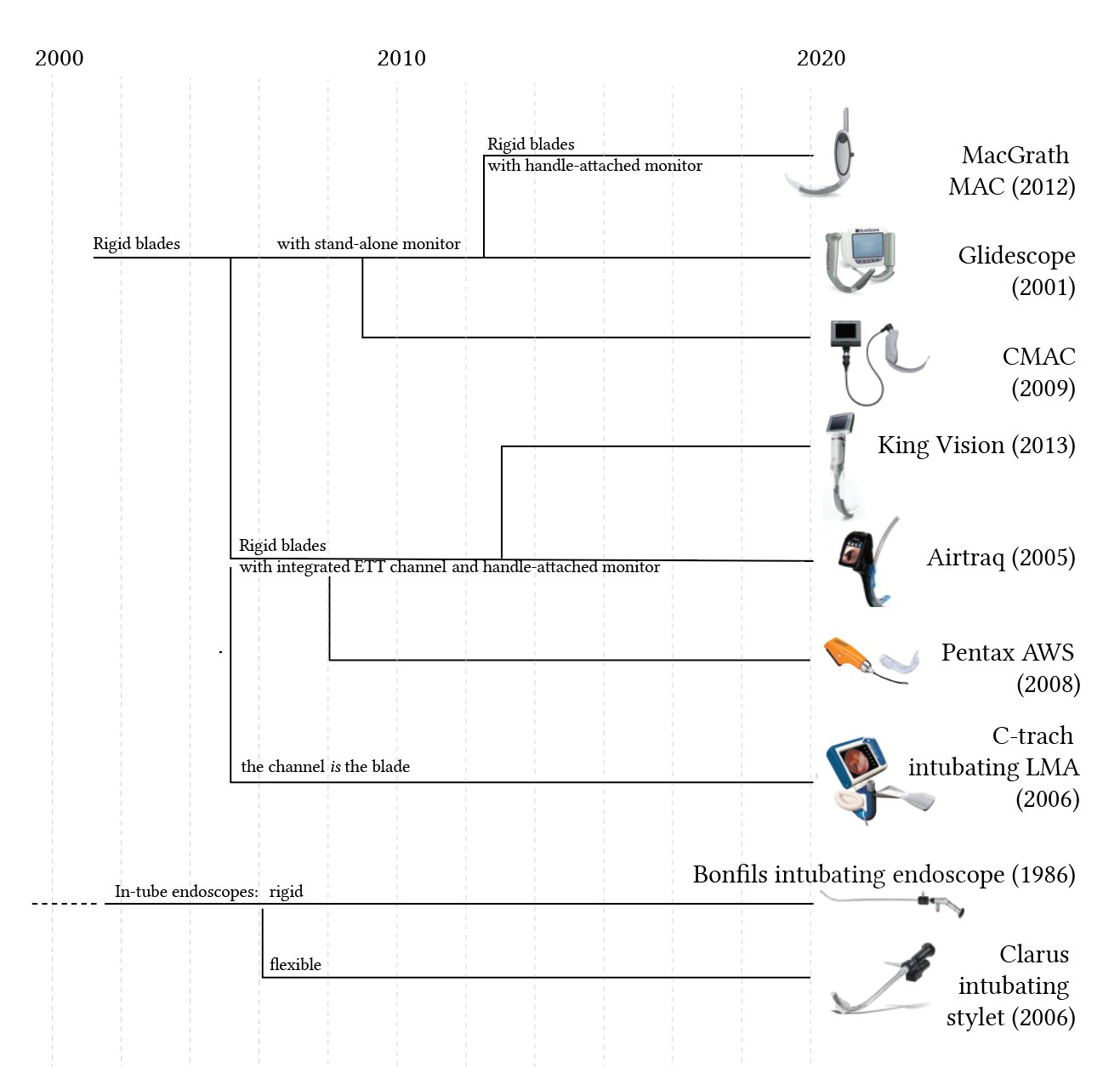
As one can see, there are many features that lend themselves well to binary forks for classification purposes, as laryngoscopes can be:
- Rigid bladed vs flexible
- Hyperangulated or standard "Mac" curve
- Channelled (i.e. an ETT slots into a groove) vs non-channelled
- Disposable blade vs. reuseable blade
- In-tube (eg. intubating stylets) vs bladed
- Those that can themselves act as airway devices (eg. the intubating video-LMA or the rigid bronchoscope)
- Screen on handle, or screen on a stand, or no screen at all (eg. the early Airtraq was technically a periscope)
And of course each of these affects the technique, as one would use a very different position and posture, and would handle the tube differently, depending on which of these features their device possesses.
Principles and practice of videolaryngoscopy
The main component of videolaryngoscopy that differs from the practice of direct laryngoscopy is the defining ability of the operator, at some point of the procedure, to take their eyes off the patient, and use a video feed from a source in the laryngoscope to guide the position of the tube. These practical differences are probably what the CICM exam trainee will need to be able to identify:
- The first stage is to introduce the device into the oropharynx, minding the teeth, tongue and lips. During this time, the operator looks at the patient in much the same way as would be expected from direct laryngoscopy.
- Rigid blade videolaryngoscopes such as the CMAC mimic the shape of the Mackintosh blade and can be used in a similar fashion, sweeping the tongue from the right side of the mouth using the broad flange of the blade
- Unflanged devices such as the McGrath anbd GlideScope cannot do the tongue-sweep and a midline approach is recommended, where the tongue is pressed to the mandible by the flat blade.
- Once in a safe position, the operator can view the image on the monitor while they manipulate the position of the scope until a satisfactory view of the glottis is achieved.
- For integrated channel devices, the tube is already loaded and can be advanced without taking one's eyes off the monitor.
- The channel direction needs to be considered, as it guides the ETT into position. The trachea descends in a different curvature to the direction into which the AirTraq points the tube tip, which may produce a "I can see it but I can't intubate it" situation; moreover the anterior tracheal rings can be a mechanical impediment to the passage of a too-steeply-angled tube, which can catch on them.
- For unchanneled devices, the operator must now look at the mouth again, place the tube into the right corner of the mouth, advance the tube into position where it could be seen by the camera, and then continue watching it on the monitor to guide the tip through the cords.
- The attention to the placement of the tube is essential here, as a focus on the monitor is neither necessary nor helpful at this point. Operators who mindlessly screen-fixated have perpetrated travesties in the oropharynx without realising.
- For hyperangulated devices without a channel, the delivery of the tube is dependent on the use of a stylet, which adds another level of challenge.
Levitan et al (2011) goes through the process and caveats in much more detail, and Lyons & O'Sullivan (2019) do a great job of summarising the detail into a quickly skimmed synopsis.
Interpretation of videolaryngoscopy findings
Yes, it is indeed bizarre to contemplate this very pragmatic task-focused procedure as something exploratory or contemplative, but this aspect is worth mentioning, if only to point out that there is more to it than simply advancing a cuffed tube through the glottis. It is possible to visualise airway structures with a high level of detail and broadcast this to all available observers, increasing the range of opinions about the swelling/bleeding/etc, but that does not call for any kind of sophisticated "interpretation". For that, we turn to the reporting of the grade of videolaryngoscopy, which is well-established and standardised for direct laryngoscopy, but much less so for videolaryngoscopy.
Grade of videolaryngoscopy
There is no accepted method of reporting the grade of videolaryngoscopy, which you could claim to remain reproducible across the impossibly wide range of different devices and the different techniques they require. Valiant efforts to introduce a system include:
- POGO, percentage of glottic opening - Ochroch et al (1999)
- Cook's modification of Cormack & Lehane classification (Cook, 2000)
- Video Classification of Intubation (VCI) score, that incorporates blade type, POGO and "ease" of intubation (Fernández-Vaquero et al 2025)
The protocol for the latter is an excellent overview of the points as to why this system is necessary. Briefly, one can imagine how difficult it would be to communicate the difficulty of intubation to somebody who has a completely different instrument with a different blade and screen orientation. Just because you got a 100% POGO view with your SlickTrach™ Ultra-Guide Pro (using the X blade), doesn't mean that in one year some poor rural ED physician is going to be able to achieve the same view using a skillet handle with a Temu webcam taped to the end. A sufficient system would therefore need to incorporate the device type used, as well as some objective features of difficulty, and perhaps even the level of experience of the operator. At present, nothing of the sort exists.
Relevant guidelines and evidence for videolaryngoscopy
Guidelines regarding videolaryngoscopy
-
ANZCA Guideline on equipment to manage difficult airways (2025): yes, you should have videolaryngoscopes for the difficult airway trolley.
-
DAS (2017): VL is an option, and if DL was your first option, VL should be the next option after a failed DL attempt. If the airway is expected to be difficult, VL should be the first option.
-
Project for Universal Management of Airways (PUMA) guidelines (Chrimes et al, 2022): "Routine use of a videolaryngoscope is recommended whenever feasible".
-
Canadian Airway Focus Group recommendations for the unexpectedly difficult airway (Law et al, 2021): "VL, with appropriately selected blade type, should be used for the first attempt at tracheal intubation".
Evidence regarding videolaryngoscopy
Yuan et al (2025) is a good meta analaysis of trials among critically ill patients which acts as an excellent bibliography for the reader who wants to quote trial acronyms. The best single-glance summary is their forest plot:
.jpg)
Notable trials comparing VL and DL:
- DEVICE - 2023 - in ICU and ED, n=1000 in the US (expected 1420, but stopped early because of clearly superior VL for first-pass success). 85.1% success with VL on the first go, vs 70./8% with DL.
- MACMAN - 2017 - n=371 in French ICUs. No difference in first pass success (67.7% vs 70.3%) with McGrath.
- Foulds - 2016 - 49 spine-collared patients in Scotland. Grade of view impoved: 92% vs. 6% had a Grade 1 view.
Controversies and risks of videolaryngoscopy
A "compare and contrast" question is a predictable trope of larygoscopy SAQs in the CICM Second Part exam, and so the controversies and risks will be approached in a manner that answers them.
Advantages of videolaryngoscopy
Arguments regarding education and communication
- You can show people what's happening. Airway anatomy can be visualised by junior team members, which prepares them for what they might expect to see when they are performing laryngoscopy themselves. Low et al (2008) used videolaryngoscopy to teach direct laryngoscopy with some degree of success. In reverse, direct laryngoscopy skills transfer well to videolaryngoscopy.
- The team can see what you're doing. The rapid response team sighs with relief as they all see the tube pass through the cords. Communication regarding difficulty is also made easier (i.e. the team leader can clearly see that you're having trouble).
- Direct laryngoscopy is dying anyway. The argument that videolaryngoscopy degrades the skills of direct laryngoscopy is similar to the argument that the printing press degraded the skills of calligraphy. Sure, you yourself might have trained in airway skills at the dawn of time, using the jawbone of an antelope as a laryngoscope, but as videolaryngoscopes become more available and their use becomes more widespread, it would be irresponsible for the training of junior medical staff to focus on obsolete devices and techniques.
Arguments regarding pragmatism
- It makes intubation easier. The ultimate quality of an intubation attempt is generally judged by whether or not the endotracheal tube ends up becoming endotracheal. Videolaryngoscopy improves the likelihood of a "successful" intubation in difficult intubation scenarios (Pieters et al, 2017) and unsorted critically ill patients (De Jong et al, 2014) as well as in general ward situations (Baek et al, 2018).
- It requires less skill. You are therefore less reliant on senior staff in the department. If you are a patient, your airway failure might be managed immediately and effectively by inexperienced junior staff, instead of having to wait for experienced seniors to arrive while your brain is stewing in hypoxia.
- It provides an official record. The laryngoscopy can be recorded for later review. When the boss ambles in at 9:30 the following morning, they can review the laryngeal oedema from the reintubation of the previous night. ENT specialists can see evidence of glottic damage without needing to perform laryngoscopy themselves, sparing the patient some trauma.
- It's not that expensive. Consider the public health cost of lifelong care for a patient disabled by a hypoxic brain injury in the wake of a preventable failed intubation. To speak nothing of the moral imperative to prevent such scenarios, the cost from purchase and maintenance of a videolaryngoscope would be covered several times over if that laryngoscope saves even one person from such an outcome during its entire operating lifespan.
Arguments regarding mechanical advantage
- It allows for a suboptimal position. In order to achieve a good view, it is not necessary to align the airway axes (oral-pharyngeal-laryngeal). This allows intubation to occur in scenarios where head and neck mobility is limited
- It allows informed assistance. Others are better able to manipulate the airway to improve your view. A blind BURP manoeuvre may actually degrade your view, but if the BURPer can see what they are doing, you are now working as a team.
- It should require less force; which should translate into less trauma and better tolerance. The upshot is the possibility of awake direct laryngoscopy, decreased mucosal trauma, less bleeding in patients with coagulopathy, less haemodynamic reflex responses to intubation and decreased induction agent requirements.
Disadvantages of videolaryngoscopy
Arguments regarding education and communication
- That's not what it looks like. Though airway anatomy is on display, the zoomed-in closeup view afforded by the videolaryngoscope is not the same as that afforded by the direct laryngoscope, and so it cannot be said to prepare junior staff for direct laryngoscopy. At this point there no studies to support videolaryngoscopy training for direct laryngoscopy outside of simulations (such as Low et al, 2008)
- The team are all watching what you are doing. The focus on the tiny webcam screen of the C-Mac takes focus off all the other tasks being performed by the intubation/resuscitation team, particularly the senior team leader who is anxiously aware of the potential need for them to step in to the role of airway technician (or cricothyroidotomist). The distraction may result in vital omissions (eg. nobody notices that the silenced monitor now displays VF). In short, it is not clear how staring at that screen is any better for communication than simply hearing the airway technician say "I'm in" or "I'm having trouble, can you have a look".
- It's too hard to teach an old dog new tricks. That change from direct line-of-sight to hand-eye-monitor coordination is widely believed to have been somehow specifically disorienting for those who already had airway skills, and had to unlearn them. This belief pervades the literature: for example, Jiang et al (2017), in their meta-analysis, concluded the experienced operators actually took longer and had more failed attempts in the pre-hospital setting. But this conclusion was reached on the basis of small studies, such as Arima et al, 2014, who randomised about a hundred Japanese cardiac arrest patients to being intubated in the usual fashion, or using a Pentax AWS; and the studies themselves actually contradict the conclusion of the meta-analysis. "We ... consider that all of the participating physicians were equally skilled to perform intubations with both", Arima et al asserted. "In general, using a video laryngoscope is easy enough to learn".
- Direct laryngoscopy will never die. The technique is "tried and tested" as only something with a hundred years of history can be. To argue that the new technique is clearly superior on the basis of only a decade of experience seems somewhat premature. Moreover, direct laryngoscopy remains the standard for routine intubation in anaesthesia, and over the course of one's anaesthetic career the vast majority of intubations will be performed with a direct laryngoscope which suggests that it is a skill worth maintaining.
Arguments from pragmatism
- The camera might get clogged with filth. The camera of the scope is a crucial failure point: the view may be obscured by secretions and blood on the camera, which will not resolve with suction. Or, the cameras may mist due to exhaled air. Or, high ambient light may make the video screen more difficult to see.
- The setup is expensive, and the components are often not disposable. The cost to a small department might be weighed against other priorities. What would you rather have, a fleet of videolaryngoscopes or an extra senior registrar? What will have a more direct positive effect on patient care?
- The maintenance if expensive and time-consuming. To sterilise equipment after use takes time, and there may be scenarios where the videolaryngoscope is out of commission for prolonged periods while waiting for the cleaning cycle to complete.
- It provides an official record. The laryngoscopy video, being on record, may now be used as a part of the argument against the airway technician if some sort of horrible problem ultimately develops which leads to medicolegal or disciplinary action. Those teeth in the video - they were clearly intact before the laryngoscopy, your honour.
- It is dangerous to describe it as the standard of care. There was a BJA editorial (Zaouter et al, 2014) which asked "why are videolarygnoscopes not used for all tracheal intubations?", suggested that "it is only a cost issue" and progressed to the blasphemy of "is it not time to integrate airway videos in the electronic charting?" The implication is that people who continue to routinely use direct laryngoscopy are not providing care at the gold standard, and if you are not posting your laryngoscopy videos to YouTube you are in dereliction of your duties. The flame war which followed in the comments section of this editorial suggests that the community of anaesthetists is currently not uniformly in favour of changing their standard of care to videolaryngoscopy.
- There are numerous devices to learn. Experience with the product of one manufacturer does not immediately guarantee the intuitive use of another device (by comparison, direct laryngoscopes are all essentially the same shape and once you're familiar with one you are familiar with them all).
Arguments regarding the supposed mechanical advantage
- Just because you can see it doesn't mean you can intubate it. Even though the glottis may be visualised without aligning the oral-pharyngeal-laryngeal axes, the ability of the operator to get the endotrachal tube into the vocal cords still requires some degree of alignment. Thus, there is no guarantee of success, even with a well-visualised glottis. You may be afforded an excellent view of your multiple failures.
- It should require less force but there is no evidence that it does. In fact, because the operator is hypnotised by the screen, the passage of airway equipment into the mouth and oropharynx is not directly observed. Dental and pharyngeal damage may result. Aziz et al (2008) reported a 1% rate of traumatic laryngoscopy, including vocal cord trauma, one tracheal injury, one trauma to the hypopharynx, one tonsillar perforation, and two dental injuries (21 cases from a series spanning 2 years).
The reader is also directed to the editorial by Norris & Heidegger (2016) for their sober take on the limitations of videolaryngoscopy, which does not cover these points, but rather pours cold water on the enthusiasm of early adopters by pointing out flaws in the available evidence at the time.
The McCoy Blade
The McCoy Articularing Tip Laryngoscope, or the levering laryngoscope as McCoy himself called it (he did not name it after himself) is an airway device designed to mechanically improve the direct laryngoscopy view. Until Question 19 from the first paper of 2019, it has only ever come up once as an "identify this item" task in Question 26.3 from the first paper of 2009, and then there was a long break until Question 1 in the first paper of 2025. The McCoy Blade has also made an appearance in Question 26.2 from the first paper of 2009.
The device itself consists of a flexible hinged blade which can augment the position of the epiglottis:

Instead of relying on brute force to elevate the epiglottis, the airway enthusiast can squeeze the lever and elevate it gently. It is particularly useful in situations where the larynx is very anterior.
The disadvantage is, sometimes the epiglottis can get caught in the hinge. Cook and Tuckey published a nice article in Anaesthesia in 1996, comparing the McCoy with the conventional Mac. It turned out that the McCoy blade in the "neutral" position actually made laryngoscopy more difficult. In the "best" position, the views achieved by both blades were similar in the vast majority of patients. The McCoy showed itself as the clear superior in truly difficult patients, where conventional laryngoscopy failed completely (i.e. it converted Grade IV views into Grade IIIs and IIs).
References
Karalapillai, Dharshi, et al. "A review of video laryngoscopes relevant to the intensive care unit." Indian Journal of Critical Care Medicine: Peer-reviewed, Official Publication of Indian Society of Critical Care Medicine 18.7 (2014): 442.
Ochroch, E. Andrew, et al. "Assessment of laryngeal view: percentage of glottic opening score vs Cormack and Lehane grading." Canadian Journal of Anaesthesia 46.10 (1999): 987-990.
Cook, T. M. "A new practical classification of laryngeal view." Anaesthesia 55.3 (2000): 274-279.
Macintosh, Robert Reynolds. "A new laryngoscope." The Lancet 241.6233 (1943): 205.
Miller, Robert A. "A new laryngoscope." Anesthesiology 2.3 (1941): 317-320.
Fernández-Vaquero, Miguel Ángel, et al. "VCISpain: Protocol for a prospective multicenter observational study to validate a standardized classification tool for tracheal intubation using videolaryngoscopy." Brazilian Journal of Anesthesiology (English Edition) (2025): 844653.
Jiang, Jia, et al. "Video laryngoscopy does not improve the intubation outcomes in emergency and critical patients–a systematic review and meta-analysis of randomized controlled trials." Critical Care 21.1 (2017): 288.
Arima, Takahiro, et al. "Comparative analysis of airway scope and Macintosh laryngoscope for intubation primarily for cardiac arrest in prehospital setting." The American journal of emergency medicine 32.1 (2014): 40-43.
Quintão, Vinícius Caldeira, et al. "Videolaryngoscopy in anesthesia and perioperative medicine: innovations, challenges, and best practices." Brazilian Journal of Anesthesiology 73.5 (2023): 525-528.
Lyons, C., and E. P. O'Sullivan. "Videolaryngoscopy–Theory and practice." Trends in Anaesthesia and Critical Care 26 (2019): 38-41.
Levitan, Richard M., et al. "The complexities of tracheal intubation with direct laryngoscopy and alternative intubation devices." Annals of emergency medicine 57.3 (2011): 240-247.
Norris, A., and T. Heidegger. "Limitations of videolaryngoscopy." BJA: British Journal of Anaesthesia 117.2 (2016): 148-150.
Williams, D., and D. R. Ball. "Palatal perforation associated with McGrath® videolaryngoscope." Anaesthesia 64.10 (2009): 1144-1145.
Higgs, A., et al. "Guidelines for the management of tracheal intubation in critically ill adults." British journal of anaesthesia 120.2 (2018): 323-352.
Chrimes, N., et al. "Preventing unrecognised oesophageal intubation: a consensus guideline from the Project for Universal Management of Airways and international airway societies." Anaesthesia 77.12 (2022): 1395-1415.
Law, J. Adam, et al. "Canadian Airway Focus Group updated consensus-based recommendations for management of the difficult airway: part 1. Difficult airway management encountered in an unconscious patient." Canadian Journal of Anesthesia/Journal canadien d'anesthésie 68.9 (2021): 1373-1404.
Yuan, Jun, et al. "Comparison of video laryngoscopy with direct laryngoscopy in critically ill patients: a systematic review and meta-analysis of randomized controlled trials." European Journal of Medical Research 30.1 (2025): 282.
https://www.thebottomline.org.uk/summaries/icm/foulds/
Foulds, L. T., B. E. McGuire, and B. J. Shippey. "A randomised cross‐over trial comparing the McGrath® Series 5 videolaryngoscope with the Macintosh laryngoscope in patients with cervical spine immobilisation." Anaesthesia 71.4 (2016): 437-442.
Prekker, Matthew E., et al. "Video versus direct laryngoscopy for tracheal intubation of critically ill adults." New England Journal of Medicine 389.5 (2023): 418-429.
Lascarrou, Jean Baptiste, et al. "Video laryngoscopy vs direct laryngoscopy on successful first-pass orotracheal intubation among ICU patients: a randomized clinical trial." Jama 317.5 (2017): 483-493.
Cooper, Richard M., et al. "Early clinical experience with a new videolaryngoscope (GlideScope®) in 728 patients." Canadian Journal of Anesthesia 52.2 (2005): 191-198.
Cavus, Erol, et al. "The C-MAC videolaryngoscope: first experiences with a new device for videolaryngoscopy-guided intubation." Anesthesia & Analgesia 110.2 (2010): 473-477.
AnaesthesiaUK have a nice page about McCoy blades.
Cook, T. M., and J. P. Tuckey. "A comparison between the Macintosh and the McCoy laryngoscope blades." Anaesthesia 51.10 (1996): 977-980.
Doyle, D. J. "A brief history of clinical airway management." Revista Mexicana de Anestesiologia 32 (2009): S164-S167.
McCoy, E. P., and R. K. Mirakhur. "The levering laryngoscope." Anaesthesia48.6 (1993): 516-519.
Chemsian, R. V., S. Bhananker, and R. Ramaiah. "Videolaryngoscopy." International journal of critical illness and injury science 4.1 (2014): 35.
Norris, A., and T. Heidegger. "Limitations of videolaryngoscopy." (2016) BJA: 148-150.
Baek, Moon Seong, et al. "Video laryngoscopy versus direct laryngoscopy for first-attempt tracheal intubation in the general ward." Annals of intensive care 8.1 (2018): 83.
Pieters, B. M. A., et al. "Videolaryngoscopy vs. direct laryngoscopy use by experienced anaesthetists in patients with known difficult airways: a systematic review and meta‐analysis." Anaesthesia 72.12 (2017): 1532-1541.
De Jong, Audrey, et al. "Video laryngoscopy versus direct laryngoscopy for orotracheal intubation in the intensive care unit: a systematic review and meta-analysis." Intensive care medicine 40.5 (2014): 629-639.
Low, D., D. Healy, and N. Rasburn. "The use of the BERCI DCI® Video Laryngoscope for teaching novices direct laryngoscopy and tracheal intubation." Anaesthesia 63.2 (2008): 195-201.
Aziz, Michael F., et al. "Routine Clinical Practice Effectiveness of the Glidescope in Difficult Airway ManagementAn Analysis of 2,004 Glidescope Intubations, Complications, and Failures from Two Institutions." Anesthesiology: The Journal of the American Society of Anesthesiologists 114.1 (2011): 34-41.
Zaouter, C1, J1 Calderon, and T. M. Hemmerling. "Videolaryngoscopy as a new standard of care." (2014): 181-183.