Pharmacokinetics of antibiotics in critical illness
For the purposes of rapid revision, the key influences on parmacokinetics in critical illness are as follows:
Factors which decrease the antibiotic peak dose:
- Poor gut absorption
- Increased volume of distribution
- Poor penetration to the site of action
Factors which increase the antibiotic peak dose:
- Decreased protein binding
- Diminished clearance mechanisms
- Improved penetration into inflamed tissues (eg. meningitis)
Factors which increase the antibiotic half-life
- Decreased renal clearance
- Decreased hepatic clearance
- Decreased overall metabolism (eg. hypothermia)
Factors which decrease the antibiotic half-life
- Renal replacement therapy
- Increased hepatic clearance, eg. enzymes induced by drug interactions
Pharmacokinetic influences of critical illness on antibiotic therapy
This diagram (or one very much like it) had come up in Question 3.2 from the second paper of 2014. In short, it represents two situations: one in which a steady concentration is maintained, and one in which there is drug accumulation and increased halflife due to ineffective clearance mechanisms. Thus, this question relates to the topic of antibiotic dosing in renal failure, which enjoys a more thorough discussion elsewhere.
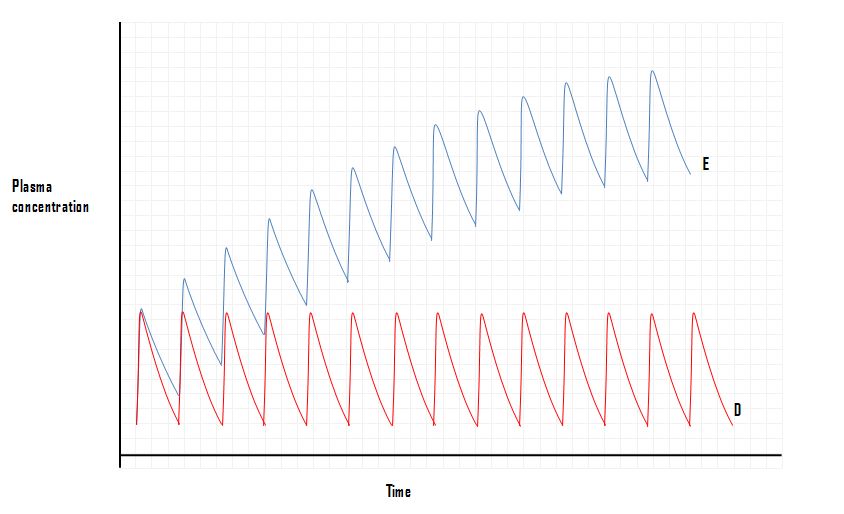
Obviously, if the MIC is somewhere halfway though the Patient D curve, all the bugs in Patient E will certainly die. However, Patient E will probably also develop tinnitus, psychosis, or bone marrow failure.
A number of factors influence the actual effective serum concenration of an antibiotic administered to a patient with critical illness. Additionally, the college asked about pharmacokinetic changes in critical illness (specifically in sepsis) in Question 10 from the second paper of 2015. An excellent article by Marta Ulldemolins (2011) goes though this very thoroughly. In brief summary:
Factors which decrease the antibiotic peak concentration:
- Changes in absorption: critically ill patients have suboptimal gut absorption.
- Volume of distribution: they are also typically fluid-overloaded, and the water-soluble antibiotics will be distributed into a larger space than anticipated.
- Penetration to the site of action: poor tissue perfusion and generalised oedema will prevent antibiotics from reaching their target site. Moreover, the target site in critical illness may be enjoying a uniquely ridiculous position in the path of circulation - for instance, the oedematous lung, or the ischaemic gut.
Factors which increase the antibiotic peak concentration:
- Protein binding: there is less albumin to bind, and generally a liver in the ICU is synthesising less binding proteins of all sorts, which will increase the free fraction of highly protein-bound drugs.
- Diminished clearance mechanisms as described below can result in an unexpectedly high peak concentration, if the drug is usually expected to have a brisk first-order elimination (i.e. the diseased shocked liver fails to metabolise the drug, and it enters the circulation in its unaltered state and in a high concentration).
Factors which increase the antibiotic half-life
- Decreased renal clearance: Obviously, drugs which are passively filtered or actively excreted by the kidneys will have a longer half-life if the kidneys aren't doing their job.
- Decreased hepatic clearance: Those antibiotics which rely on biliary excretion or actual metabolism will begin to accumulate if the liver is damaged (i.e. the synthetic function is poor) or if its blood flow is diminished (eg. in any sort of shock state).
- Decreased overall metabolism is an influence exerted by hypothermia, and affects mainly the drugs which are subject to hepatic clearance.
Factors which decrease the antibiotic half-life
- Renal replacement therapy is usually less efficient at removing drugs than the original kidneys, but in some instances (classically, for fluconazole) CRRT clearance may actually be more efficient for whatever reason.
- Increased hepatic clearance: The hepatic blood flow may actualy be increased if the circulation is hyperdynamic; alternatively, hepatic enzymes may be induced by drug interactions, thereby enhancing elimination by this pathway.
- Increased glomerular filtration: also due to the effect of a hyperdynamic circulation.
- Increased drug metabolism due to a "hypermetabolic" state induced by trauma, burns and exogenous catecholamine infusions
Pharmacodynamic influences of critical illness on antibiotic therapy
In Question 1 from the first paper of 2000, the candidates were invited to "List briefly ways in which clinical illness can change the pharmacokinetics and pharmacodynamics of antibiotic therapy". The pharmacokinetics side of things is well covered above; pharmacodynamics are more tricky. The college answer dwells on the increased susceptibility to organ toxicity, for "vulnerable" organs such as under-perfused kidneys, and other such factors. Unfortunately, this is all you get when you search for this in the literature.
Enhanced organ toxicity
Antibiotic toxicity will increase not only because clearance might be impaired, but because the organs themselves are likely damaged, and are therefore relatively defenceless. Toxicity may develop at drug levels which might otherwise be viewed as safe. Examples of this may include:
- Increased nephrotoxicity from aminoglycosides, if the renal function is already impaired
- Increased cardiotoxicity from bleomycin and vancomycin
- Increased risk of QT prolongation and arrhythmia with fluoroquinolones in the context of cardiac ischaemia, profound hypothermia, or extreme electrolyte derangement
- Increased bone marrow toxicity from linezolid, cotrimoxazole, gancyclovir, chloramphenicol, beta-lactams of all sorts...
- With a disrupted blood-brain barrier, an increased risk of seizures from high-dose beta-lactams, due to enhanced penetration.
- Worsening shock due to dapsone-induced methaemoglobinaemia and thus diminished oxygen-carrying capacity.
Interaction of septic shock and antimicrobial pharmacology
In Question 10 from the second paper of 2015, the examiners asked us to "outline how the pathophysiological changes in septic shock affect the pharmacokinetics and pharmacodynamics of commonly used antimicrobials". The college then went on to give an answer which - if transposed verbatum - would have perfectly answered Question 1 from the first paper of 2000. They just listed the pharmacological changes in critical illness. What was specific to sepsis in there? Nothing. And then, they did it all again in Question 27 from the second paper of 2020. One must suppose we need repeats to give us all a chance.
Fortunately there are some articles which address this issue more directly. For instance, De Paepe et al (2002) offer a detailed treatise on this topic. It's practically designed to answer Question 10. Many of the issues are the same (septic shock is after all a "critical illness" ) but a few interesting tidbits are specific to sepsis. These have been summarised into point form, all the better to plug in to the SAQ discussion. The changes are largely pharmacokinetic. The authors lament: "Our literature search yielded only one clinical study that investigated the pharmacodynamics of a drug during septic shock" (it was dobutamine).
Pharmacokinetic changes unique to sepsis and septic shock
- Increased volume of distribution due to sepsis-associated "capillary leak" results in a decreased effective concentration of antimicrobials. Sure, capillaries get leaky in lots of other disease states, but sepsis and SIRS are especially prone to this.
- Decreased bioavailability of basic drugs: because α-1-acid glycoprotein is an acute phase reactant and can be expected to be elevated in sepsis (though to be completely fair it is also elevated in many other disease states: Piafsky et al (1978) have demonstrated increased levels in patients with Crohns disease, as one example).
- Increased penetration of formerly impenetrable tissues due to their inflamed state, as in the enhanced penetration of β-lactams into the CNS which is associated with meningitis
- Impaired hepatic metabolism due to inhibition of CYP-450 enzymes by endotoxin seems to be unique to sepsis, as endotoxaemia is a uniquely bacterial phenomenon. Muller et al (1996) have demonstrated that this is due to endotoxin-mediated release of nitric oxide, which interferes with metabolic enzyme function by oxidising the heme in the cytochrome proteins.
Dose adjustment for antimicrobial agents
Question 19 from the antibiotic-mad second paper of 2015 presented the candidates with a series of "pharmacodynamic profiles", and then asked about pharmacokinetics of antibiotic dose adjustment.

Obviously in Scenario 1 the antibiotics will never be effective as the MIC is never achieved, and in Scenario 2 the antibiotics will kill the bugs shortly before they kill the patient with toxicity. In Scenario 3, one might argue that nothing nees to change for antibiotics with concentration-dependent killing; whereas those with time-dependent killing should probably be dosed more regularly (or given as an infusion).
References
Craig, William A. "Pharmacokinetic/pharmacodynamic parameters: rationale for antibacterial dosing of mice and men." Clinical infectious diseases (1998): 1-10.
Ulldemolins, Marta, et al. "Antibiotic dosing in multiple organ dysfunction syndrome." CHEST Journal 139.5 (2011): 1210-1220.
Trotman, Robin L., et al. "Antibiotic dosing in critically ill adult patients receiving continuous renal replacement therapy." Clinical infectious diseases 41.8 (2005): 1159-1166.
Drusano, George L. "Antimicrobial pharmacodynamics: critical interactions of'bug and drug'." Nature Reviews Microbiology 2.4 (2004): 289-300.
De Paepe, Peter, Frans M. Belpaire, and Walter A. Buylaert. "Pharmacokinetic and pharmacodynamic considerations when treating patients with sepsis and septic shock." Clinical pharmacokinetics 41.14 (2002): 1135-1151.
Piafsky, Kenneth M., et al. "Increased plasma protein binding of propranolol and chlorpromazine mediated by disease-induced elevations of plasma α1 acid glycoprotein." New England Journal of Medicine 299.26 (1978): 1435-1439.
Muller, Claudia M., et al. "Nitric oxide mediates hepatic cytochrome P450 dysfunction induced by endotoxin." The Journal of the American Society of Anesthesiologists 84.6 (1996): 1435-1442.