Distribution of cations in body fluid compartments
Total body sodium content
- You have 60mmol/Kg of sodium. A 70kg male has about 4200mmol, or about 92g of sodium.
- Of this, 70% is “exchangeable” and the rest is locked up in bone crystal.
- Extracellular fluid contains 50% of the total body sodium;
- Intracellular fluid contains 5% of the total body sodium.
The “Plasma Solids Effect”
Plasma is 93% water and 7% solids. When plasma sodium is measured, typically the concentration is not much different than in the interstitial fluid. BUT: there is actually more sodium in the plasma, because it is attracted there by the Gibbs-Donnan effect of all those anionic plasma proteins. Measuring the sodium content of plasma water alone would reveal a substantially higher concentration.
Gibbs-Donnan Effect
Anionic plasma proteins attract sodium into the plasma. An equilibrium is reached where the sodium concentration in the plasma remains slightly higher, and the chloride concentration in the plasma is slightly lower (chloride ends up being higher in the interstitial fluid)
Na+/K+ ATPase activity
Sodium concentration inside the cell is kept artificially low by the action of Na+/K+ ATPase, which exchanges 3 sodium atoms for every 2 potassium.
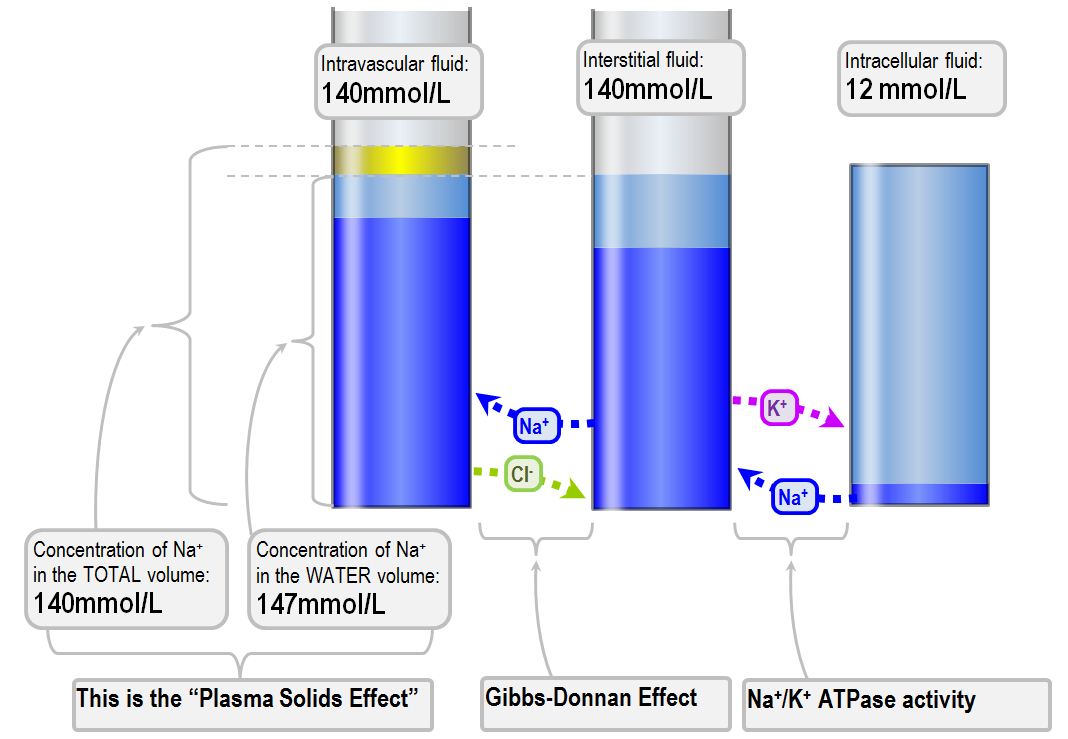
The “Plasma Solids Effect”
Plasma is 93% water and 7% solids. When plasma sodium is measured, typically the concentration is not much different than in the interstitial fluid. BUT: there is actually more sodium in the plasma, because it is attracted there by the Gibbs-Donnan effect of all those anionic plasma proteins. Measuring the sodium content of plasma water alone would reveal a substantially higher concentration.
Gibbs-Donnan Effect
Anionic plasma proteins attract sodium into the plasma. An equilibrium is reached where the sodium concentration in the plasma remains slightly higher, and the chloride concentration in the plasma is slightly lower (chloride ends up being higher in the interstitial fluid)
Na+/K+ ATPase activity
Sodium concentration inside the cell is kept artificially low by the action of Na+/K+ ATPase, which exchanges 3 sodium atoms for every 2 potassium.
Total body potassium content
- You have 40mmol/Kg of potassium. A 70kg male has about 2800mmol, or about 109g of potassium.
- Of this, 90% is in the intracellular fluid. This is the only exchangeable potassium.
- Extracellular fluid contains 2% of the total body potassium, and bone contains 8%

Potassium equilibrates freely and rapidly across the extracellular fluid
There isn’t enough of it to matter seriously in any of the Gibbs-Donnan effects, or to contribute significantly to the various osmolar forces. It merely exists.
Na+/K+ ATPase activity
Potassium concentration inside the cell is kept artificially high by the action of Na+/K+ ATPase, which exchanges 3 sodium atoms for every 2 potassium.
One's intracellular stores of potassium are not distributed as homogeneously as the shiny purple-filled cylinder would have you believe. According to Vander's Renal physiology the skeletal muscle contains most of one's potassium stores, because it contributes the largest intracellular volume to the overall count. Cells differ somewhat in their potassium content, and this gives rise to a confusing plethora of values one can find quoted in the physiology textbooks (from 120 to 150mmol/L)
Total body calcium content
- You have about 360mmo/kg of calcium in your body; that makes about 25 moles of calcium.
- A 70kg male has about 25 moles of calcium, or about 1000g.
- Of this, over 99% is locked up in bone. 500mmol is exchanged between bone and ECF over a 24 hr period
- About 30 mmol of calcium is in the extracellular fluid. (that’s 2.4 (mmol/L) x 12.6L (functional ECF volume of a 70Kg person)
- About 7mmol is in the circulating blood.
Intracellular calcium is minimal; It is an important second messenger.
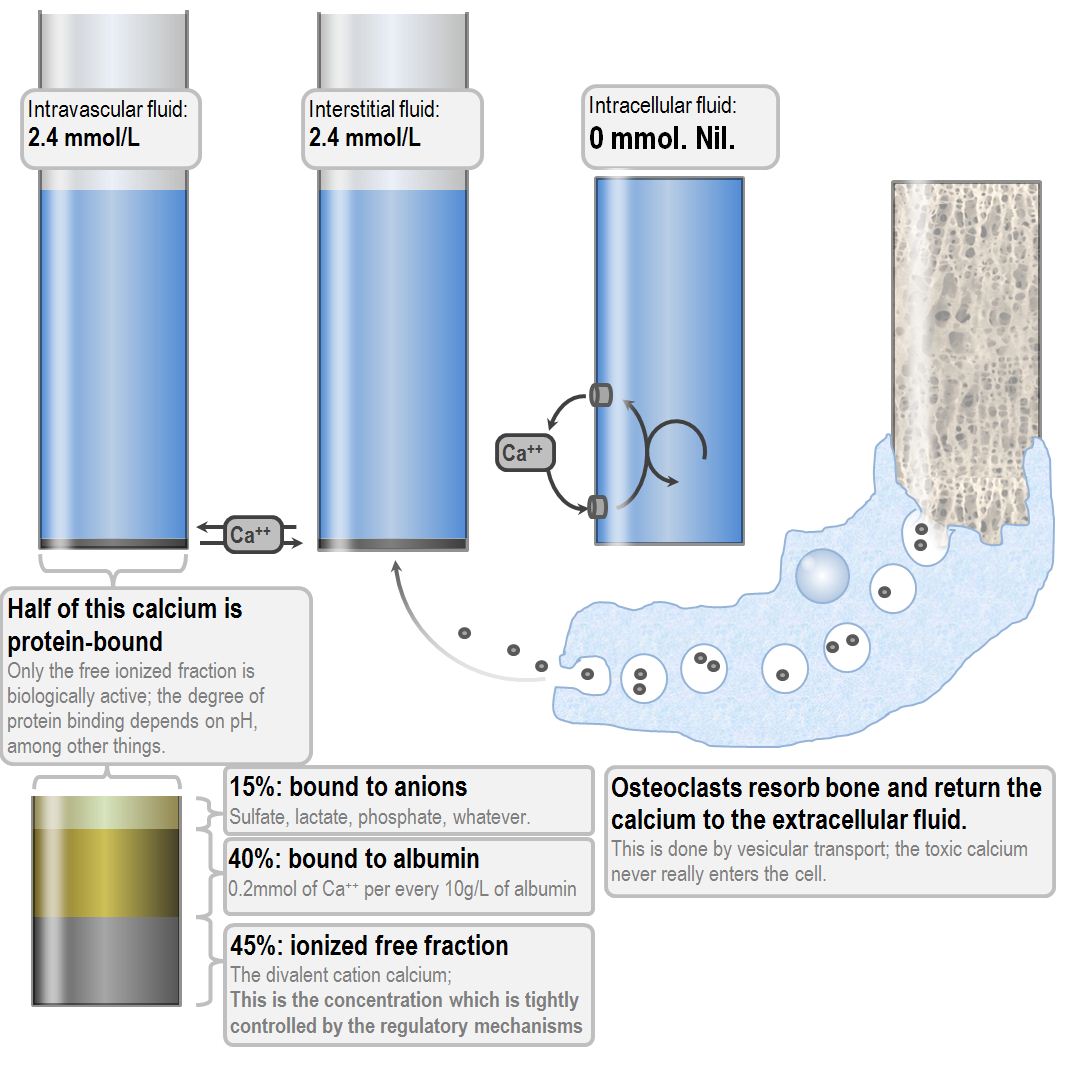
Calcium is kept out of the cell actively by ATP-powered pumps; its important for it to stay out because it is a second messenger.
Elsewhere, more extensive discussions are available regarding the measurement of ionised calcium, and the influence of pH on the contrast between total and ionised calcum measurement.
Total body magnesium content
- You have about 15 mmol/Kg of magnesium
- A 70kg male has about 1050 mmol, or about 700g of magnesium.
- Of this, 60% is locked up in bone.
- 39% is intracellular, and 1% is in the extracellular fluid.
- That means, the ECF contains only about 10mmol.
- Of the serum magnesium, about 40% is protein bound (just like calcium)

Magnesium equilibrates freely across the extracellular fluid
There isn’t enough of it to matter seriously in any of the Gibbs-Donnan effects, or to contribute significantly to the various osmolar forces. Like potassium, it merely exists.
Magnesium enters cells freely, without the need for active transport.
But we still don’t know how. Doesn’t look like there is any sort of transporter. Changes in the ECF magnesium concentration result in a slow change of intracellular magnesium concentration.
Intracellular magnesium is bound to ATP, cell wall lipids and many various enzymes.
Those enzymes require magnesium to function. Plus magnesium, like calcium, binds to the phosphorylated groups of the cell wall lipids, and acts as a membrane stabilizer. Thus there isn’t very much free magnesium in the actual cell water; its all complexed
Magnesium potentiates the effects of neuromuscular blockade (both depolarizing and non-depolarising).
References
Most of this information derives from easily accessible physiology textbooks, such as Ganongs Review of Medical Physiology 23rd edition.
Another reference I used was this eMedicine article. This guy from Yale also wrote a beautiful thesis on this topic, to which I tip my hat. Furthermore, see these electrolyte discussions in the Electrolyte Quintet series from the Lancet..